
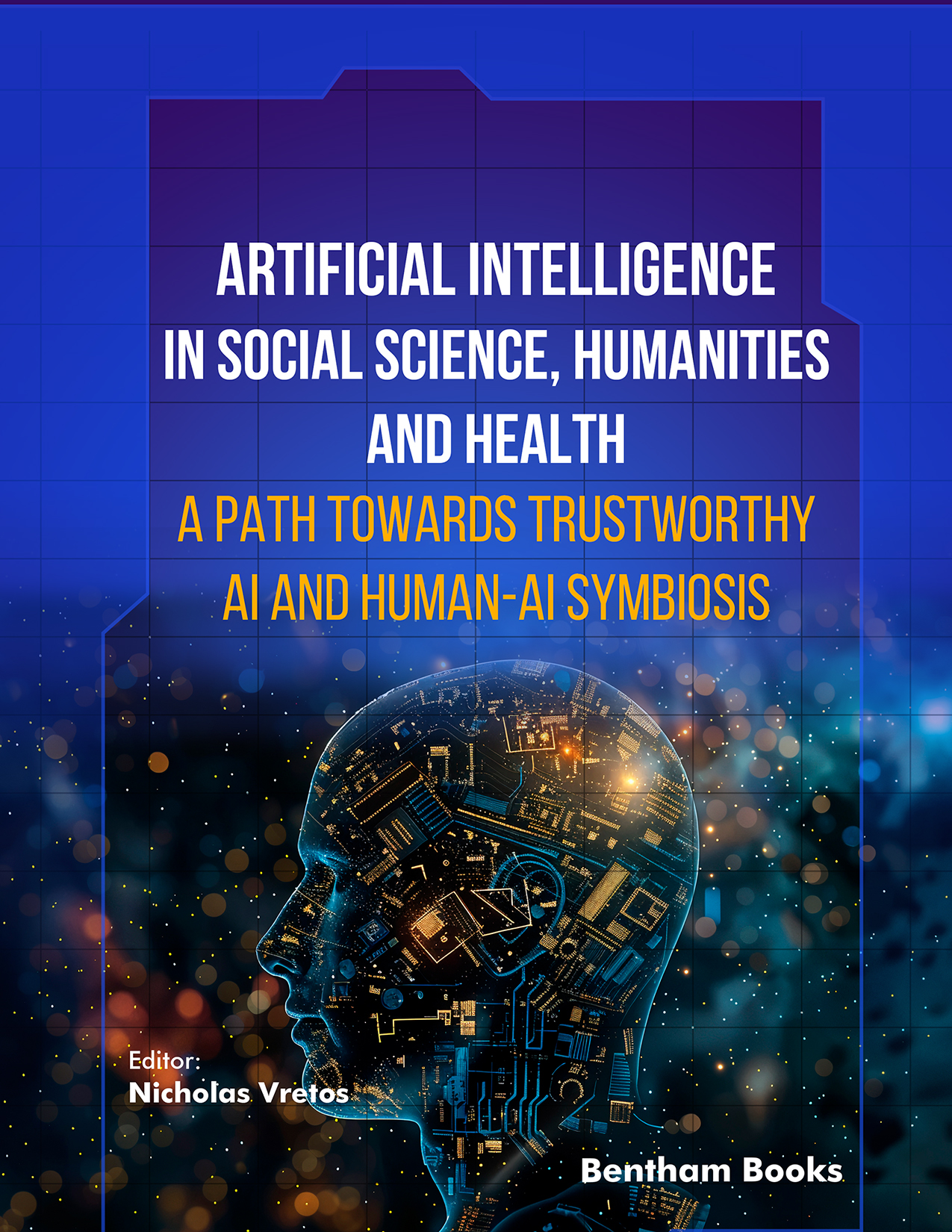
Artificial Intelligence in Social Science, Humanities and Health: A Path Towards Trustworthy AI and Human-AI Symbiosis

Editor: Nicholas Vretos

Artificial Intelligence in Social Science, Humanities and Health: A Path Towards Trustworthy AI and Human-AI Symbiosis

ISBN: 979-8-89881-817-3
eISBN: 979-8-89881-816-6 (Online)

Introduction

This edited volume explores AI's transformative reach across healthcare, the social sciences, and the humanities, centered on two guiding ideas: Human-AI Symbiosis, where AI amplifies rather than replaces human insight, and Trustworthy AI, emphasizing transparency, fairness, accountability, and robustness in intelligent systems.

Nine interdisciplinary chapters trace AI's evolving role — from foundational machine learning and deep learning concepts, to AI-powered healthcare platforms and multimodal clinical decision support, to breakthroughs in biomedical microscopy. The collection also tackles pressing ethical and legal frameworks for responsible AI, collaborative innovation in protein interaction research, AI's growing influence on political discourse, privacy-by-design architecture, agent-based modelling in archaeology, and AI's expanding footprint in literature and the arts.


Key Features

  • - Bridges technical AI advances with real-world human impact across diverse fields.
  • - Balances theoretical depth with practical, applied case studies.
  • - Addresses urgent ethical, legal, and societal questions shaping AI's future.
  • - Showcases cross-disciplinary collaboration between technology, science, and the humanities.

This book is a timely, multidisciplinary resource for anyone invested in building AI that works with humanity — not apart from it.


Target Readership :

Primary readers: Scholars, researchers, and practitioners in AI, data science, healthcare, and the humanities/social sciences seeking rigorous, interdisciplinary perspectives.

Secondary readers: Graduate students and policymakers interested in the ethical, legal, and societal dimensions of emerging AI technologies.

Contributors

Editor(s):
Nicholas Vretos
Visual Computing Lab
Information Technologies Institute
Centre For Research and Technology Hellas
Thermi 57001, Greece


Contributor(s):
Anastasia Iatrou
Institute of Applied Biosciences
Centre for Research and Technology Hellas
Thermi 57001
Greece


Anestis Kastellos
Department of Electrical and Computer Engineering
Democritus University of Thrace
Xanthi 67132
Greece


Anestis Kaimakamidis
Department of Informatics
Aristotle University of Thessaloniki
Thessaloniki 54124
Greece


Angelos-Michael Papadopoulos
Visual Computing Lab
Information Technologies Institute, Centre of Research Technology Hellas
Thermi 57001
Greece


Antonia Zoi Kouroutzidou
Institute of Applied Biosciences
Centre for Research and Technology Hellas
Thermi 57001
Greece


Apostolos Axenopoulos
School of Rural and Surveying Engineering
Aristotle University of Thessaloniki
Thessaloniki 54124
Greece


Audrey Dequesness
Faculty of Law, Social and Political Sciences
University of Lille
Duez, Lille 59000
France


Banafshe Arbab-Zavar
Faculty of Science and Technology
Bournemouth University
Poole BH12 5BB, Dorset
United Kingdom


Damianos Charcharidis
Visual Computing Lab
Information Technologies Institute, Centre of Research Technology Hellas
Thermi 57001
Greece


Eirini Kondyli
Department of Informatics
Aristotle University of Thessaloniki
Thessaloniki 54124
Greece


Federico Alvarez
Departamento de Señales, Sistemas y Radiocomunicaciones
Universidad Politécnica de Madrid
Madrid 28040
Spain


Giorgos Sanidas
Department of Art histoy and archaeology
Université de Lille
Lille 59000
France


Ioannis Mademlis
Department of Informatics
Aristotle University of Thessaloniki
Thessaloniki 54124
Greece


Ioannis Pitas
Department of Informatics
Aristotle University of Thessaloniki
Thessaloniki 54124
Greece


Konstantinos Marthoglou
Visual Computing Lab
Information Technologies Institute, Centre of Research Technology Hellas
Thermi 57001
Greece


Kostas Stamatopoulos
Institute of Applied Biosciences
Centre for Research and Technology Hellas
Thermi 57001
Greece


Kosmas Dimitropoulos
Visual Computing Lab
Information Technologies Institute, Centre of Research Technology Hellas
Thermi 57001
Greece


Nicholas Vretos
Visual Computing Lab
Information Technologies Institute, Centre of Research Technology Hellas
Thermi 57001
Greece


Petros Daras
Visual Computing Lab
Information Technologies Institute, Centre of Research Technology Hellas
Thermi 57001
Greece


Stamatia Laidou
Institute of Applied Biosciences
Centre for Research and Technology Hellas
Thermi 57001
Greece


Tilak Ginige
Faculty of Science and Technology
Bournemouth University
Poole BH12 5BB, Dorset
United Kingdom


Timothy Albiges
Faculty of Science and Technology
Bournemouth University
Poole BH12 5BB, Dorset
United Kingdom


Vasileios Mygdalis
Faculty of Business and Economics, Department of Marketing, University of Antwerp
Antwerp 2000, Belgium School of Informatics, Aristotle University of Thessaloniki
Thessaloniki 54124
Greece


Vassilis Solachidis
Visual Computing Lab
Information Technologies Institute, Centre of Research Technology Hellas
Thermi 57001
Greece


Yiannis S. Boutalis
Department of Electrical and Computer Engineering
Democritus University of Thrace
Xanthi 67132
Greece


Zoheir Sabeur
Faculty of Science and Technology
Bournemouth University
Poole BH12 5BB, Dorset
United Kingdom