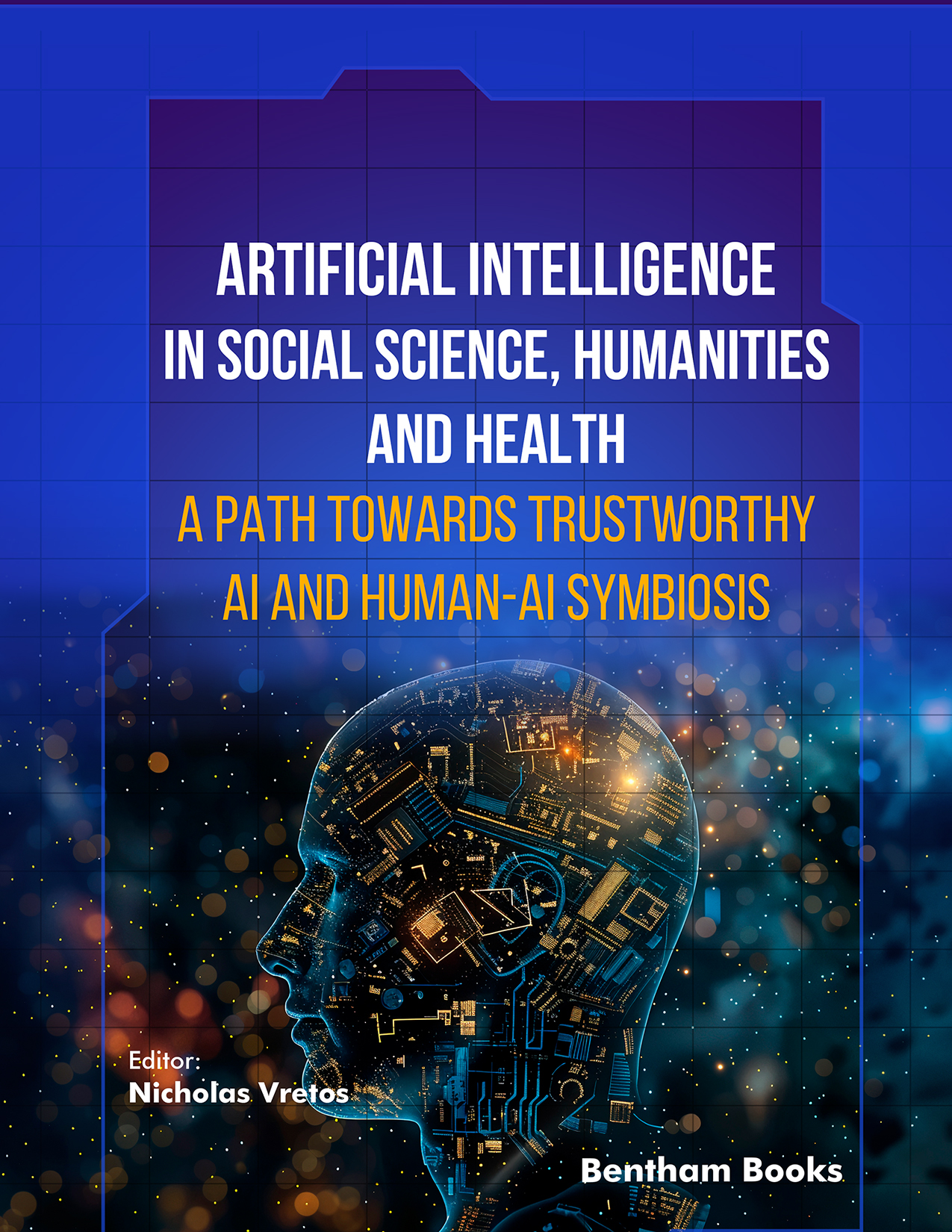
Artificial Intelligence (AI) continues to redefine the boundaries of knowledge creation, decision-making, and cultural interpretation across disciplines. Its expanding presence in fields such as healthcare, social sciences, and the humanities has generated transformative opportunities alongside urgent challenges. This edited volume, Artificial Intelligence in Social Science and Humanities and Health: A Path Towards Trustworthy AI and Human-AI Symbiosis, brings together a diverse, interdisciplinary collection of contributions that reflect the current landscape of AI in human-centered domains.
A key unifying theme throughout the book is the concept of Human-AI Symbiosis. Far from positioning AI as a replacement for human insight, the contributions here envision AI as a collaborative partner—a system designed to amplify human values, creativity, and capabilities. Symbiosis in this sense is a call for thoughtful co-evolution between technological design and social purpose, where machine intelligence is developed not in isolation but in continuous alignment with human needs and contexts.
Equally central is the goal of building Trustworthy AI. Across domains, the demand for AI systems that are transparent, fair, accountable, and robust has become a defining concern. The chapters in this volume collectively engage with this objective by showcasing applications and theoretical approaches that embody these principles.
Each chapter offers a distinct but interconnected contribution to this vision:
• AI-Driven Insights for Enhanced Healthcare: Leveraging Multimodal Data in eHealth Platforms presents integrated AI approaches for clinical decision support and personalized medicine.
• Current Trends, Innovations and Challenges in the Use of Artificial Intelligence in Microscopy explores how AI accelerates scientific discovery in the field of biomedical imaging.
• Data Science and Artificial Intelligence Under Ethics and Legal Perspectives discusses normative and legal frameworks essential to responsible AI deployment in society.
• AI-Promoted Protein-Protein Interaction Site Identification and Analysis: Recent Advances in Public-Private Innovations highlights collaborative research environments where AI bridges institutional boundaries in health and biotech.
• AI and Politics examines the role of AI in shaping political discourse, electoral influence, and democratic processes.
• Privacy-by-Design AI introduces architectural strategies for embedding data protection and transparency at the core of intelligent systems.
• Agent-Based Modelling (ABM) in Archaeology: A Useful Tool for Studying Past Human Societies demonstrates how simulation models offer new pathways for cultural and historical interpretation.
• Recent Advances in AI for Literature and Art investigates how AI technologies intersect with the creative process, reshaping the way we understand and produce literature and visual culture.
Together, these chapters illuminate the complex, often reciprocal relationships between technological systems and human values. This book is intended for scholars, researchers, practitioners, and students engaged in AI, data science, healthcare, the humanities, and the social sciences. It aims to provide both theoretical depth and applied insight for those working toward responsible, human-centered innovation.
Acknowledgements
This volume would not have been possible without the dedication and intellectual generosity of the contributing authors. We also extend our appreciation to the reviewers who offered critical feedback and to the editorial and production teams who supported the realization of this project. Above all, we acknowledge the broader community of interdisciplinary researchers striving to ensure that AI evolves not only with technical excellence, but with ethical foresight and societal relevance.
Nicholas Vretos
Visual Computing Lab
Information Technologies Institute
Centre For Research and Technology Hellas
Thermi 57001, Greece