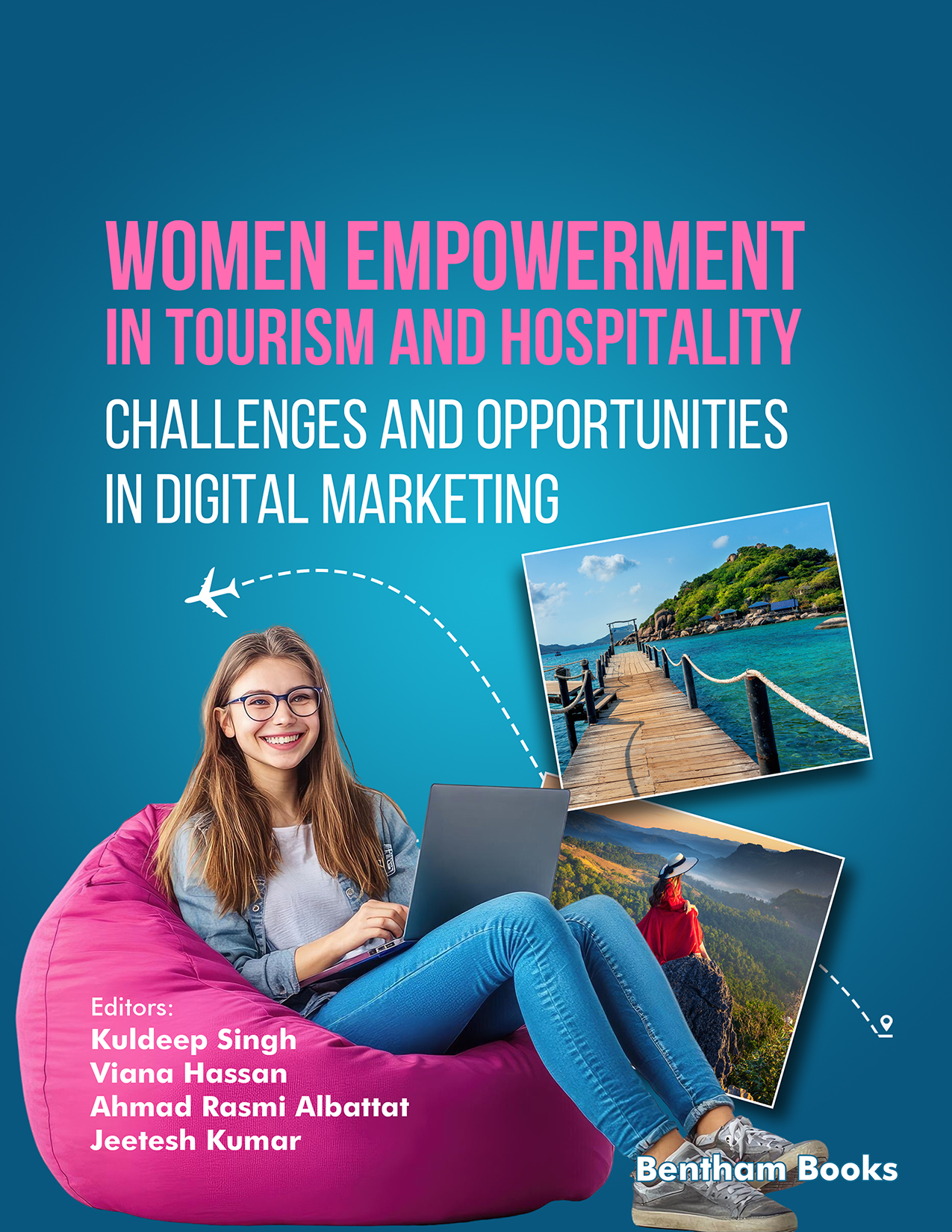
The tourism industry plays a pivotal role in global economic development, and empowering women in the digital sector is essential to advancing women's empowerment through digital marketing. “Women Empowerment in Tourism and Hospitality: Challenges and Opportunities in Digital Marketing” is a comprehensive book that explores the challenges and opportunities women face in the tourism industry and offers transformative strategies for empowerment through digital marketing. This book explores the significance of digital marketing and women's empowerment in the tourism and hospitality industry. It delves into the challenges and opportunities that women face when using social media in the tourism sector.
This book combines research insights, case studies, and practical guidance to provide a roadmap for fostering digital marketing and promoting women's leadership in the dynamic world of tourism. This book proposal explores how women's empowerment through digital marketing is shaping the future of travel, hospitality, and the overall tourism experience. The proposed book is designed to serve as a comprehensive guide for industry professionals, scholars, and enthusiasts seeking to understand the profound impact of technological advancements on the tourism sector. It will offer a detailed analysis of the latest innovations, their implementation, and the resulting paradigm shifts within the industry.
Chapter 1: Women's Empowerment in Tourism: A Systematic Review of the Literature
The tourism sector plays a central role in the global economy, generating employment and promoting sustainable development. Although women represent a significant portion of the workforce in this sector, they still face structural challenges such as wage inequality, limited access to leadership positions, and precarious working conditions. This study performs a systematic review of the literature on female empowerment in tourism and hospitality, analysing the state of the art and outlining possible paths for future research. The research focused on two main subfields: Social Sciences and Business, Management, and Accounting.
Chapter 2: Role of women empowerment in tourism and hospitality through Digital Marketing: Global context
This chapter examines the connection between women's empowerment, the tourism and hospitality industry, and digital marketing. This study examines the ways in which various digital platforms serve as gateways to opportunities for women, thereby exploring the concept of women’s empowerment. Technological advancements in digital marketing have lowered traditional barriers for women, enabling them to acquire businesses in tourism and hospitality. Studies conducted in Europe, America, and Southeast Asia have documented how women have used digital platforms to promote local tourism and hospitality services in their countries, thereby reaching a larger audience and increasing employment.
Chapter 3: Trends in Women's Empowerment Research: A Bibliometric Analysis of India
Over the past four decades, the realm of women's empowerment has witnessed significant evolution, capturing the attention of academic researchers worldwide. In line with this, our research aims to conduct a comprehensive bibliometric analysis that illuminates the key dimensions of women's empowerment literature, specifically within the Indian context. By meticulously examining 519 scholarly papers published between 1986 and 2022, sourced from the esteemed Scopus database, we aim to unravel the intricate interconnections, identifythematic clusters, and explore the citation patterns to construct an insightful text-based map.
This study is of great significance, as it sheds light on various aspects of the discourse on Indian women's empowerment.
Chapter 4: Gender Stereotypes in Tourism and Hospitality Sector at a Glance
Gender stereotypes have long influenced societal dynamics, including the tourism and hospitality sectors, where traditional roles and biases often dictate personnel and guest interactions. This paper explores the intricate relationship between gender stereotypes and the tourism and hospitality industry through a multifaceted analysis. The introduction sets the stage by highlighting the prevalence and significance of addressing gender biases in this domain. The ancient context delves into the historical emergence of gender functions and classical anticipations within the industry. The revelation of stereotypes examines how biases permeate personnel roles, leadership positions, and visitor perceptions.
Chapter 5: Digital Revolution: The Transformative Role of Social Media in Asian Women’s Empowerment
The recent digital revolution has transformed societal formations and social communication standards, making social media the most crucial empowerment weapon. In Asia, where social, cultural, and economic conditions are varied and complex, social media platforms have become codified tools for women through platforms like Facebook, Twitter, Instagram, and YouTube, paving the way for Asian women’s empowerment. The chapter examines the transformative potential of social media in promoting women's decorative rights in Asian Countries, with the aim of empowering it to interrogate entrenched patriarchal structures and catalyse positive social change.
Chapter 6: Role of Women Bloggers in Promoting Tourism Destinations
The tourism industry has undergone significant transformations in recent years, driven by the rise of digital technologies and social media platforms. One of the key drivers of this transformation has been the emergence of peregrinating bloggers, who have become influential voices in shaping tourist comportments and destinations. Among these bloggers, women have played a pivotal role in promoting tourism destinations, leveraging their unique perspectives, experiences, and online communities to showcase the magnetizations and cultures of sundry destinations.
Chapter 7: Role of Women Bloggers in Empowering Local Communities through Food Tourism
In the age of digital connectivity, blogging has become a powerful tool for storytelling, influencing, and community development. Within the tourism industry, women bloggers are carving out a significant space by showcasing cultural heritage, promoting sustainable practices, and supporting local economies. This chapter examines the role of women bloggers in tourism, the challenges they encounter, and their potential to transform communities and narratives within the global tourism landscape.
Chapter 8: The Role of Social Media in Shaping Hotel Decision-Making Among Female Tourists: A Study on Information Evaluation, Trust, and Visual Influence
This study explores how social media influences the hotel selection process for women consumers in Delhi/NCR, India, focusing on the evaluation stage, during which they search, compare, and choose hotels. The aim is to provide insights to help stakeholders in the Indianhotel industry optimize social media platforms, emphasizing key factors in online hotel bookings. Using an exploratory qualitative approach, the study conducted 30 in-depth, semistructured interviews with social media users, selected through non-random, purposive sampling.
Chapter 9: The Role of Digital Marketing in Driving Women's Success in Tourism and Hospitality
The integration of digital marketing in the tourism and hospitality sector has immensely helped create opportunities for women, including entrepreneurship, professional roles, and leadership. This chapter explains how digital transformation in hospitality and tourism helps women access opportunities, increase their career visibility, launch innovative startups, and overcome traditional barriers to success. It provides women with a way to advance their careers by utilising tools such as social media, Search Engine Optimisation (SEO), and customer engagement, thereby building goodwill in the market.
Chapter 10: A Case Study on Empowering Women in Tourism: Leveraging Digital Marketing for Sustainable Development
The tourism industry serves as a powerful platform for empowering women, fostering inclusive economic growth, and promoting sustainable development. This case study, "Empowering Women in Tourism: Leveraging Digital Marketing for Sustainable Development," highlights the transformative impact of digital marketing on women-led tourism initiatives. It examines real-world success stories of organizations and brands that have enabled women to overcome socio-economic barriers and thrive in the tourism sector. Notable examples include the Self-Employed Women’s Association (SEWA) in India, which has utilized digital platforms to market handicrafts and local experiences, and Women in Travel CIC in the UK, which supports female entrepreneurs through mentorship and digital marketing training.
Chapter 11: Digital Entrepreneurship and Women’s Work-Life Balance: A Transformative Paradigm
The advent of digital entrepreneurship has redefined professional landscapes, empowering women to transcend traditional barriers associated with work-life balance, societal norms, and financial limitations. Technology has revolutionised business models, enabling women entrepreneurs to harness digital platforms to create successful enterprises while simultaneously managing familial and personal responsibilities. This chapter delves into the convergence of leadership, digital business, and work-life balance, particularly examining the psychological, social, and economic challenges women entrepreneurs face. A compelling case study featured in this discussion is that of Priyanka Tiwari, a travel blogger and digital entrepreneur, whose robust online presence boasts over 2.78 million YouTube subscribers and 116,000 social media followers.
Chapter 12: Inspiring Women in Digital Business: Journeys of Leadership and Innovation
The digital business world is increasingly being shaped by women who are not only breaking glass ceilings but also redefining what it means to lead in a technology-driven era. From founding disruptive startups to scaling global enterprises, women leaders are leveraging digital tools, artificial intelligence, and data-driven strategies to create innovative solutions and drive economic growth (McKinsey, 2022). Their journeys are marked by resilience, adaptability, and a commitment to inclusivity, making them powerful role models for aspiring entrepreneurs.
Chapter 13: Balancing Self, Family, and Business: A Juggling Life among Female Business Leaders
The purpose of this study is to highlight the joys and sorrows, case studies, and strategies usually taken by women who become business leaders. This study used various literature that was considered applicable to describe the phenomena experienced by women who play two roles, namely in the domestic and public spheres. The results of this study aim to provide a holistic view of the experiences of women businesspeople. The case studies that follow are based on the experiences of women businesspeople who have been covered and featured in media releases.
Chapter 14: Applications of Tourism Technology in Contemporary Women's Entrepreneurship for Managing Handicraft Business
Women's empowerment primarily aims at self-realisation and at seeking support from local stakeholders. Women have set up Self-Help Groups (SHGs) to foster interaction with various stakeholders. This study aims to investigate the effects of technology on women's entrepreneurship in managing their handicraft businesses. The study's findings suggest that various internal and external factors drive the growth of handicraft businesses, promoting entrepreneurship and digital innovation.
Chapter 15: Women's Empowerment and Digital Marketing in Tourism in Madagascar and Indonesia
Digital marketing has become an important component of the business strategy to optimize sales and revenue, expand the market, and maximize the business's competitive advantage. It is vital for startups and small and medium enterprises, as it does not require a huge investment. Since the implementation of these marketing tools has become a significant component of the business strategy, having the ability and capacity to manage and master them is one of the keys to business success, especially for startups and SMEs. This chapter discusses the role of digital marketing in promoting sustainable tourism in rural tourism and gender equity. This chapter presents empirical evidence from rural tourism in Madagascar and Indonesia.
Chapter 16: In the best interest of the child: Norwegian approach to Parenting or Cultural Disparities? Through the lens of Netflix Special: Mrs. Chatterjee VS Norway
Media plays an important role in shaping and influencing our opinions and beliefs about different castes, religions, cultures, and communities. Media has certainly bridged the gap between what we already know and what we want to know. However, media also has several effects on its viewers. This is why it is always recommended that the content viewed be at the viewer's discretion. Our understanding of the film Mrs. Chatterjee VS Norway helps explain disparities across genders, cultures, and parenting. Movie analysis is one of the various elements of media psychology that help us view content mindfully, with a psychological perspective, and think beyond what we see on the screen, especially about how we process the content.
Chapter 17: The Wander Woman Effect: Connecting Gratifications to Intentions in Tourism Content Creation
This study explores how different types of gratifications—utilitarian, hedonic, content, and social—influence behavioral intention to follow recommendations from female travel influencers on social media. The research employed a quantitative approach, collecting data from 206 respondents via an online survey. The data were analyzed using SPSS for regression analysis and WarpPLS for Structural Equation Modeling (SEM) to test the proposed hypotheses. The results revealed that all four gratifications significantly impact behavioral intention.
Chapter 18: Addressing Gender Stereotypes in Tourism and Hospitality Sector: Best Practices and Policy Recommendations
This chapter aims to address the issue of gender stereotypes in hospitality and tourism management. The study examines contemporary gender ideas and provides pertinent examples from hospitality and tourism management. Moreover, this study also suggests a four-point critical agenda for gender research in tourism and hospitality. Emphasizing obstacles such as work-life balance issues, discrimination, and lack of mentoring, this chapter also explores the challenges and triumphs of women in leadership and entrepreneurial roles in this sector.
CONCLUDING REMARKS
Through an interdisciplinary approach, this work addresses the intricate challenges, opportunities, and long-term goals of digital marketing for women's empowerment in the tourism industry. Women's empowerment and digital marketing are closely related in various ways, as digital marketing provides opportunities to amplify women's voices, increase their economic independence, and enhance their access to global markets. Digital marketing offers women the tools to start and scale businesses with minimal capital. Platforms such as social media, e-commerce websites, and content marketing enable women to promote products, services, or personal brands.
This book will be a significant contribution to the very limited knowledge in this identified research area. Potential research can be an added value for tourism management and organizational behavior aftermath such issues are deeply investigated.
Kuldeep Singh
Amity School of Hospitality
Amity University, Gurugram
Haryana, India
Viana Hassan
European Tourism and Events Training Academy
American University of Malta
Bormla, Malta
Ahmad Rasmi Albattat
Asia Pacific University of Technology and Innovation
Kuala Lumpur
Malaysia
&
Jeetesh Kumar
Faculty of Social Sciences & Leisure Management
Taylor’s University
Subang Jaya
Malaysia