
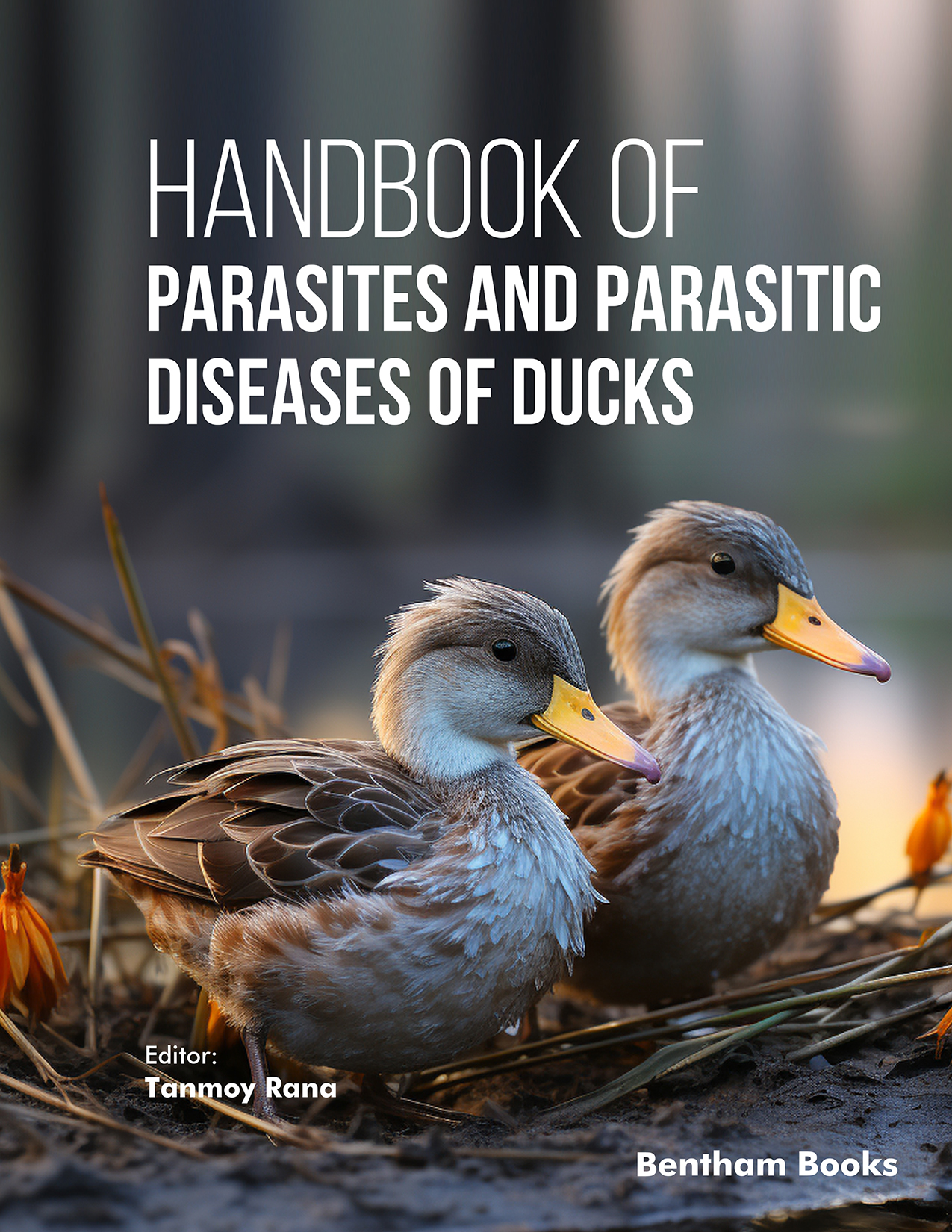
Handbook of Parasites and Parasitic Diseases of Ducks

Editor: Tanmoy Rana

Handbook of Parasites and Parasitic Diseases of Ducks

ISBN: 979-8-89881-748-0
eISBN: 979-8-89881-747-3 (Online)

Introduction

Handbook of Parasites and Parasitic Diseases of Ducks explains the major parasitic diseases affecting ducks and their impact on flock health, productivity, and public health. It covers the biology, life cycles, transmission, diagnosis, treatment, and prevention of both internal and external parasites commonly found in wild and domesticated ducks. The handbook also examines epidemiological risk factors associated with aquatic environments and different production systems, helping readers understand how parasites spread and how infections can be effectively managed.

This handbook combines essential scientific knowledge with practical disease management strategies. It is aimed as an essential resource for understanding how to improve duck health and sustainable poultry production for a wide range of academic and professional readers.


Key Features

  • - Systematically covers helminths, protozoa, and ectoparasites affecting ducks.
  • - Explains parasite life cycles, transmission routes, and disease mechanisms.
  • - Describes modern diagnostic methods and immunological responses.
  • - Provides practical guidance on antiparasitic treatments, prevention, and biosecurity.
  • - Provides information on advanced topics like zoonotic risks, drug resistance, vaccine development, and emerging parasitic diseases.
  • - Includes references for further reading.

Target Readership :

This is a textbook for students of veterinary medicine and zoology, and a practical handbook for researchers, veterinarians, poultry professionals and duck farmers.

Foreword

The book titled ‘Handbook of Parasites and Parasitic Diseases of Ducks’ is one of the books expected to meet the needs of students and scholars of Veterinary Medicine, Animal Science, and Zoology. The book is written because there is a lack of detailed literature on the parasites infecting both domestic and wild ducks.

The book comprises twenty-two chapters with comprehensive and detailed explanations not only of the parasites or disease entities but also of their economic, social, and public health importance. It covers most aspects of parasite morphology, pathophysiology, immune response to infection, economic impact, diagnosis, treatment, control, and the zoonotic importance of the parasites of ducks. It also offers useful and appropriate suggestions based on sound epidemiological considerations. I commend the authors of the various chapters for this wonderful account of this important and somewhat neglected subject.

I personally recommend the book to all categories of students at universities, colleges, and research institutes, particularly those in departments such as Zoology, Veterinary Science, Medical Science, and Animal Science with an interest in parasitology. Prospective readers who have majored in all branches of parasitology will certainly find the book interesting and highly educative.

Aliyu Mahmuda
Department of Veterinary Parasitology and Entomology
Faculty of Veterinary Medicine
Usmanu Danfodiyo University
Sokoto, Nigeria