
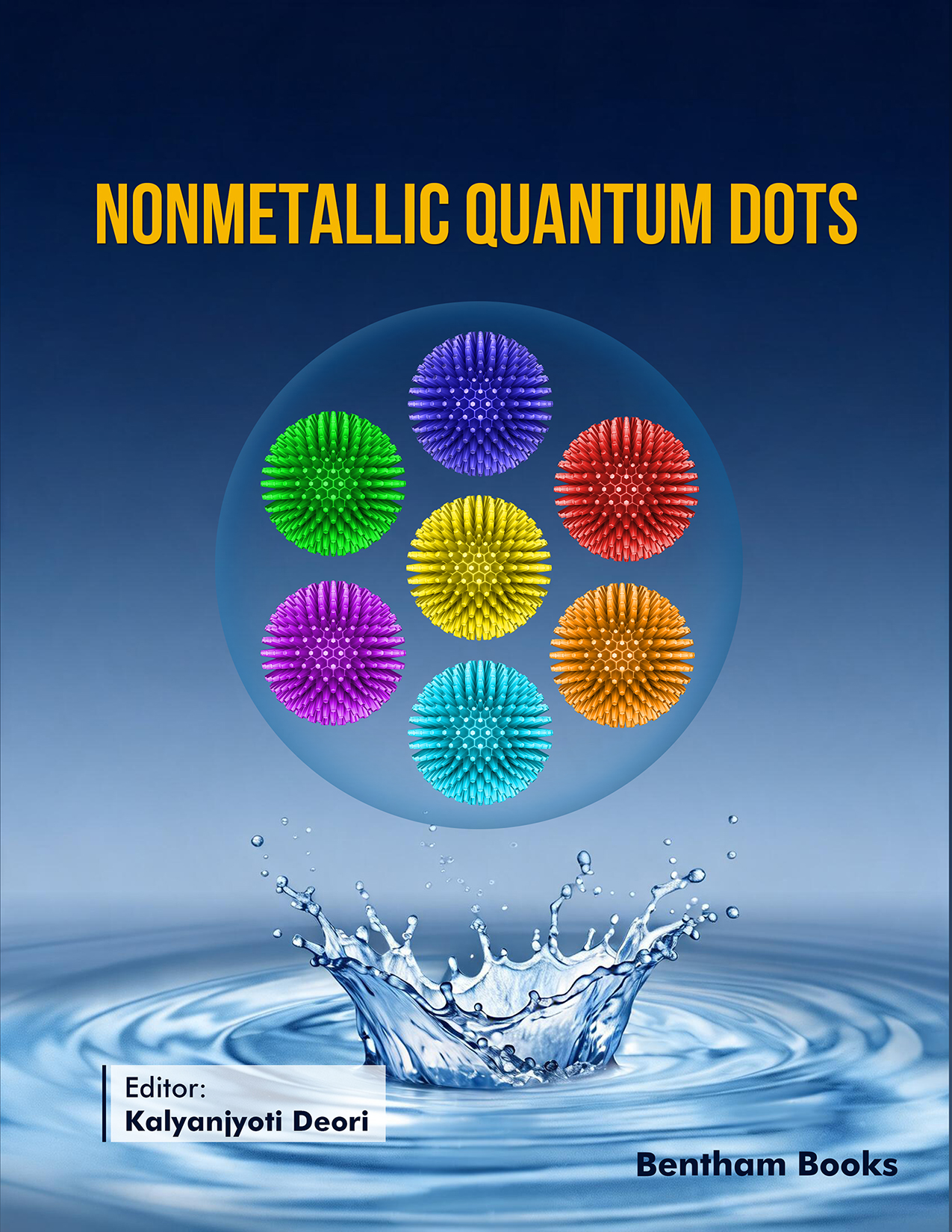
Editor: Kalyanjyoti Deori

Nonmetallic Quantum Dots

eBook: US $129 Special Offer (PDF + Printed Copy): US $207
Printed Copy: US $142
Library License: US $516
ISBN: 979-8-89881-655-1 (Print)
ISBN: 979-8-89881-654-4 (Online)
Year of Publication: 2026
DOI: 10.2174/97988988165441260101

Introduction

Nonmetallic Quantum Dots is a concise yet comprehensive exploration of non- metallic quantum dots and their growing importance in nanotechnology, environmental science, and biomedicine.

The book begins with the fundamentals of quantum dots, exploring the types, structure, properties, and historical development, followed by their role in water treatment and environmental remediation. It explores major nonmetallic quantum dots like carbon (CQDs), graphene (GQDs), boron nitride (BNQDs), silicon (SiQDs), sulphur (SQDs), and organic quantum dots (OQDs), focusing on their synthesis, properties, and functionalization.

The book highlights key applications supported by real-world case studies across water purification, photocatalysis, bioimaging, biosensing, drug delivery, optoelectronics, energy storage, and antimicrobial systems, while also addressing surface modification, stability, toxicity, environmental impact, commercialisation challenges and future research directions.


Key Features

  • - Covers all major non-metallic types of quantum dots
  • - Clear explanations on synthesis, functionalization, and photocatalysis
  • - Insights into safety, toxicity, and commercialisation
  • - Case studies and future perspectives with applications in healthcare, environment, and energy systems

Target Readership:

Researchers, postgraduate students, and professionals in nanotechnology, materials sciences and chemistry.

Foreword

Quantum dots (QDs) have emerged as a transformative class of nanomaterials, distinguished by their exceptional optical, electronic, and catalytic properties. Their versatility has opened new frontiers across various scientific domains, including catalysis, energy conversion, biomedical imaging, and environmental remediation. While conventional metallic QDs, such as cadmium and lead-based systems, have demonstrated remarkable efficacy, concerns about their toxicity and environmental impact have spurred the search for safer alternatives. This pursuit has led to the rise of nonmetallic quantum dots (NMQDs)—a class of materials that offer comparable or superior performance while minimizing ecological and health risks.

This book, “Nonmetallic Quantum Dots”, provides a comprehensive examination of the synthesis, properties, and diverse applications of NMQDs, positioning them as sustainable alternatives to traditional metallic counterparts. It addresses the critical need for sustainable and non-toxic materials in the field of water treatment, offering insights into the potential of non-metallic QDs to revolutionize water purification technologies. It offers an in-depth analysis of various types of NMQDs, including carbon, silicon, graphene, boron nitride, sulfur, and organic-based quantum dots. Each chapter not only explores their unique physicochemical characteristics but also delves into their practical utility across emerging fields—ranging from photocatalysis and energy storage to antimicrobial activity and advanced sensing technologies. A distinguishing feature of this book is its holistic approach to both the scientific fundamentals and real-world applications of NMQDs. It covers key topics such as the mechanisms underpinning their enhanced catalytic activity, innovations in surface functionalization, and their potential for addressing global challenges. The inclusion of case studies and comparative analyses further enriches the discussion, offering readers a practical understanding of how NMQDs are shaping next-generation technological solutions.

Beyond their functional capabilities, the book also addresses critical issues surrounding the environmental and health impacts of NMQDs. It emphasizes the importance of developing scalable, cost-effective, and environmentally responsible manufacturing processes while highlighting the need for regulatory frameworks to ensure safe implementation. By fostering a balanced perspective between innovation and sustainability, this work provides a roadmap for the responsible advancement of NMQD technologies. The breadth and depth of this book make it a valuable resource for researchers, industry professionals, and policymakers engaged in nanoscience, materials chemistry, and environmental technology. As the global scientific community strives to develop cutting-edge materials for a more sustainable future, “Nonmetallic Quantum Dots” serves as both a foundational text and a forward-looking guide, inspiring future research and real-world innovation.

It is with great enthusiasm that the authors introduce this timely and significant contribution to the expanding field of quantum dot research, offering a vision where scientific progress aligns seamlessly with environmental responsibility and human well-being.

Sabu Thomas
Chairman
Trivandrum Engineering Science &
Technology Research Park
(TrEST Research Park)
Thiruvananthapuram 695016, Kerala, India

Director
School of Energy Materials
Mahatma Gandhi University,
Kottayam 686560, Kerala, India

Director,
School of Nanoscience and Nanotechnology
Mahatma Gandhi University,
Kottayam 686560, Kerala, India

Director, International and Inter-University Centre
for Nanoscience and Nanotechnology,
Mahatma Gandhi University,
Kottayam 686560, Kerala, India

Chief Editor
Nano-Structures & Nano-Objects
Elsevier


&

Former Vice Chancellor
Mahatma Gandhi University
Kottayam 686560, Kerala, India