
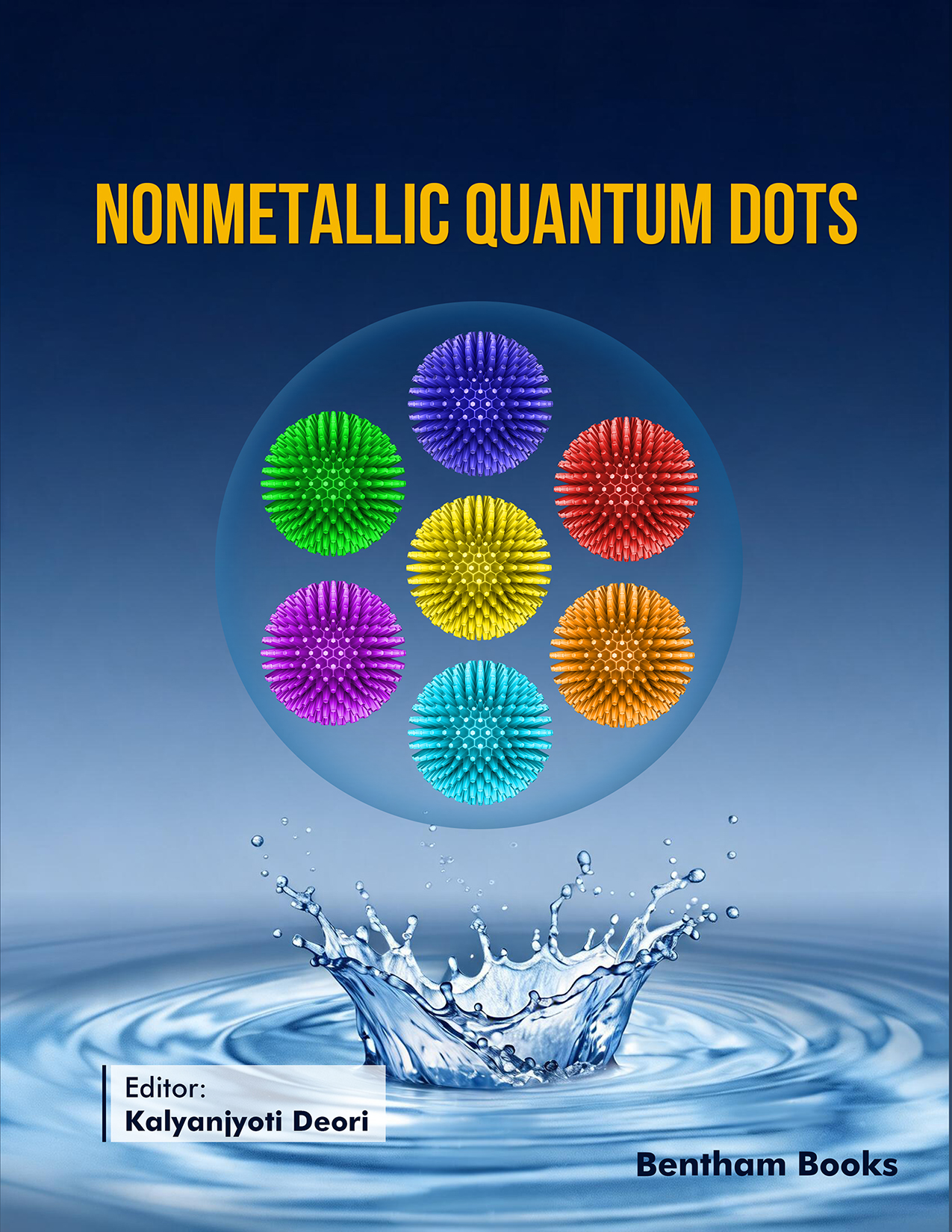
Editor: Kalyanjyoti Deori

Nonmetallic Quantum Dots

eBook: US $129 Special Offer (PDF + Printed Copy): US $207
Printed Copy: US $142
Library License: US $516
ISBN: 979-8-89881-655-1 (Print)
ISBN: 979-8-89881-654-4 (Online)
Year of Publication: 2026
DOI: 10.2174/97988988165441260101

Introduction

Nonmetallic Quantum Dots is a concise yet comprehensive exploration of non- metallic quantum dots and their growing importance in nanotechnology, environmental science, and biomedicine.

The book begins with the fundamentals of quantum dots, exploring the types, structure, properties, and historical development, followed by their role in water treatment and environmental remediation. It explores major nonmetallic quantum dots like carbon (CQDs), graphene (GQDs), boron nitride (BNQDs), silicon (SiQDs), sulphur (SQDs), and organic quantum dots (OQDs), focusing on their synthesis, properties, and functionalization.

The book highlights key applications supported by real-world case studies across water purification, photocatalysis, bioimaging, biosensing, drug delivery, optoelectronics, energy storage, and antimicrobial systems, while also addressing surface modification, stability, toxicity, environmental impact, commercialisation challenges and future research directions.


Key Features

  • - Covers all major non-metallic types of quantum dots
  • - Clear explanations on synthesis, functionalization, and photocatalysis
  • - Insights into safety, toxicity, and commercialisation
  • - Case studies and future perspectives with applications in healthcare, environment, and energy systems

Target Readership:

Researchers, postgraduate students, and professionals in nanotechnology, materials sciences and chemistry.

Preface

Water is an indispensable resource, critical to life and the health of our ecosystems. However, the challenges of water scarcity and pollution are escalating globally, driven by population growth, industrial activities, and climate change. Effective water treatment technologies are urgently needed to ensure access to clean and safe water. Quantum dots (QDs) have emerged as promising materials in the field of water treatment due to their unique optical and electronic properties. Yet, the widespread use of metallic quantum dots, such as those based on cadmium and lead, poses significant environmental and health risks.

This book, “Nonmetallic Quantum Dots,” aims to explore and present the potential of nonmetallic quantum dots as nontoxic and environmentally friendly alternatives. Nonmetallic QDs, including carbon, graphene, boron nitride, silicon, sulfur, and various organic-based quantum dots, offer a promising path forward. They provide comparable, if not superior, performance in water purification and pollutant detection, while significantly reducing the associated risks. The motivation for this book arises from the need to balance technological advancement with environmental sustainability. By focusing on nonmetallic quantum dots, we address the dual goals of improving water treatment efficiency and minimizing ecological and health impacts. This book provides a comprehensive review of the latest research, synthesis methods, properties, and applications of nonmetallic QDs in water treatment.

Throughout this book, readers will find detailed discussions on the mechanisms of pollutant removal, the advantages and challenges of nonmetallic QDs, and real-world case studies that highlight their practical applications. The aim is to equip researchers, engineers, policymakers, and environmental scientists with the knowledge needed to advance this important field. We hope this book will inspire further research and innovation in the development of safe and sustainable water treatment technologies, contributing to the global effort to secure clean water for all. The insights provided here are intended to pave the way for future breakthroughs and to foster a deeper understanding of the critical role that nonmetallic quantum dots can play in addressing one of the most pressing environmental challenges of our time.

I would like to extend my sincere gratitude to all the chapter contributors, whose expertise and dedication have enriched this book with valuable insights into the rapidly evolving field of nonmetallic quantum dots. I am also deeply appreciative of the broader community of academicians and researchers whose pioneering work continues to push the boundaries of this field, fostering innovation and sustainable advancements. A special thanks to Bentham Science Publications for their constant support and guidance throughout the publication process, making this collaborative effort possible.

Kalyanjyoti Deori
KD’s ‘NAME’ (NanoMat&Energy) Lab
Department of Chemistry
Dibrugarh University
Dibrugarh 786004
Assam, India