
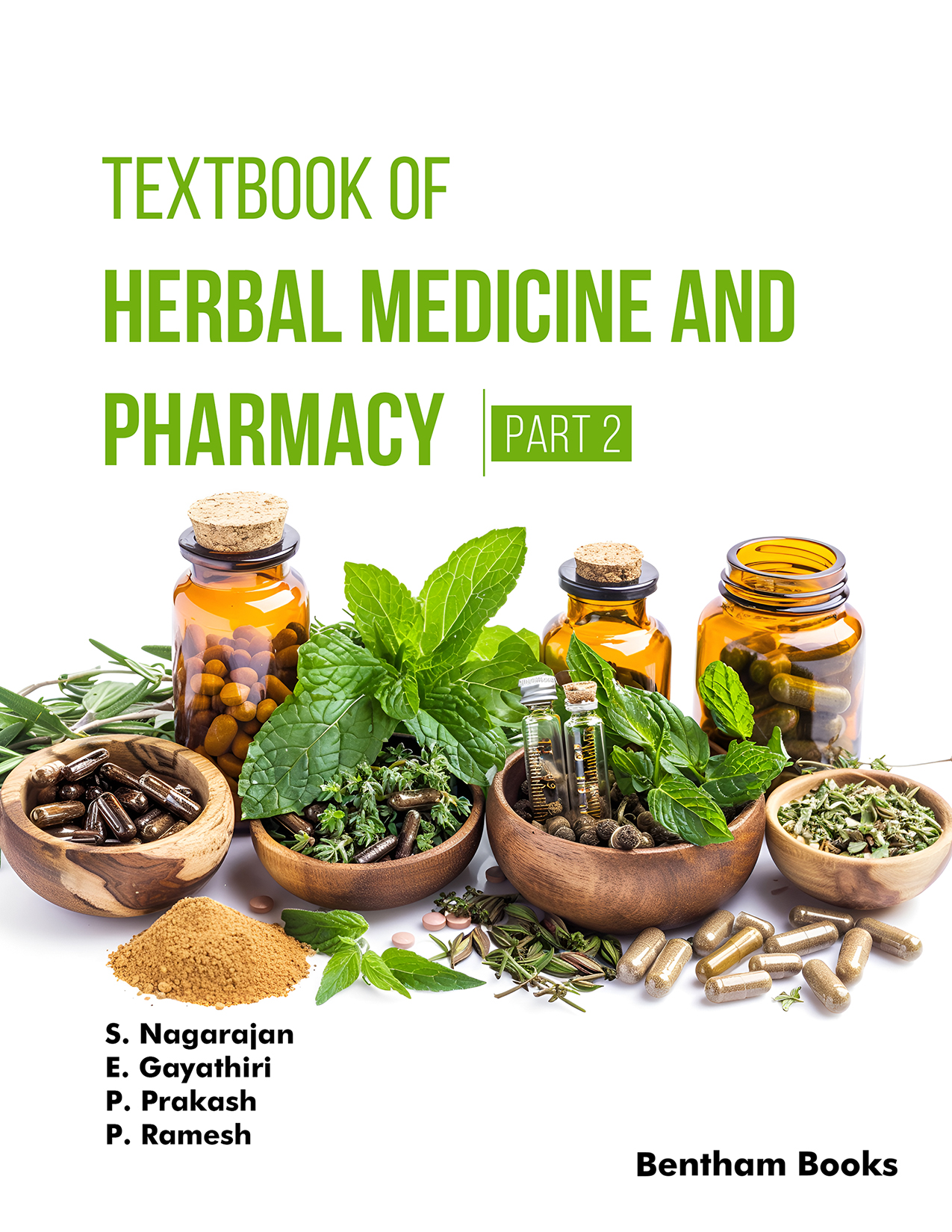
Textbook of Herbal Medicine and Pharmacy (Part 2)

Authors: S. Nagarajan, E. Gayathiri, P. Prakash, P. Ramesh

Textbook of Herbal Medicine and Pharmacy (Part 2)

ISBN: 979-8-89881-634-6
eISBN: 979-8-89881-633-9 (Online)

Introduction

Textbook of Herbal Medicine and Pharmacy is a comprehensive two-part resource that connects traditional knowledge of medicinal plants with modern scientific principles and pharmaceutical applications. Designed primarily for students, the textbook provides a structured understanding of herbal medicine fundamentals and contemporary technologies used in therapeutic development.


Key Features

  • - Understand the fundamental principles and scope of herbal medicine and pharmacy.
  • - Connect traditional medicinal knowledge with modern scientific approaches.
  • - Learn about the cultivation, processing and value addition of medicinal plants.
  • - Learn about the methods of Identifying, evaluating and screening bioactive compounds.
  • - Explore herbal drug formulation, dosage forms and pharmaceutical applications.
  • - Discover emerging approaches, including network pharmacology, artificial intelligence, and computational drug discovery.

Part 2 explains the scientific evaluation and pharmaceutical development of herbal medicines. Chapters cover the classification of secondary metabolites, identification of bioactive components, and the use of bioassays and pharmacological screening to assess therapeutic potential. The volume also discusses the formulation and dosage forms of herbal drugs. Finally, it introduces network pharmacology, artificial intelligence, and computational drug discovery as emerging approaches for understanding and developing herbal medicines.


Readership :

Students in pharmacy, pharmacology, medicinal chemistry and herbal medicine courses. Trainers and educators in herbal medicine programs.

Foreword

Herbal medicine and pharmacy have experienced an incredible revolution over the last few decades due to improvements in the areas of phytochemistry, pharmacology, biotechnology, and computational biology. The traditional system of knowledge is currently being justified using scientific methods, resulting in the creation of safer, more effective, and evidence-based herbal formulations.

Textbook of Herbal Medicine and Pharmacy (Part 2) is a comprehensive and systematic discussion of secondary metabolites, bioassays, pharmacological screening, formulation science, and novel technologies, including network pharmacology and the integration of multi-omics. The book manages to reconcile classical herbalism with the new pharmaceutical sciences, affording the students and researchers a multidimensional perspective of the therapeutics of plants.

The biochemical pathways, pharmacological mechanisms, and technological approaches have been presented in a very systematic and understandable way by the authors. Most modern aspects, like the integration of AI, systems pharmacology, and computational modeling, are included, which makes this work very relevant to contemporary research and clinical practice.

The book will be of great use to undergraduate and postgraduate students of pharmacy, pharmacognosy, biotechnology, and life sciences and researchers and professionals in the fields of herbal drug discovery and development.

I would recommend the book to the scholarly world, as it is a valuable addition, and this textbook will surely contribute greatly to the academic and research community.

Sivakumar Vijayaraghavalu
Department of Medical Sciences & Technology
IIT Madras, Tamil Nadu, India