
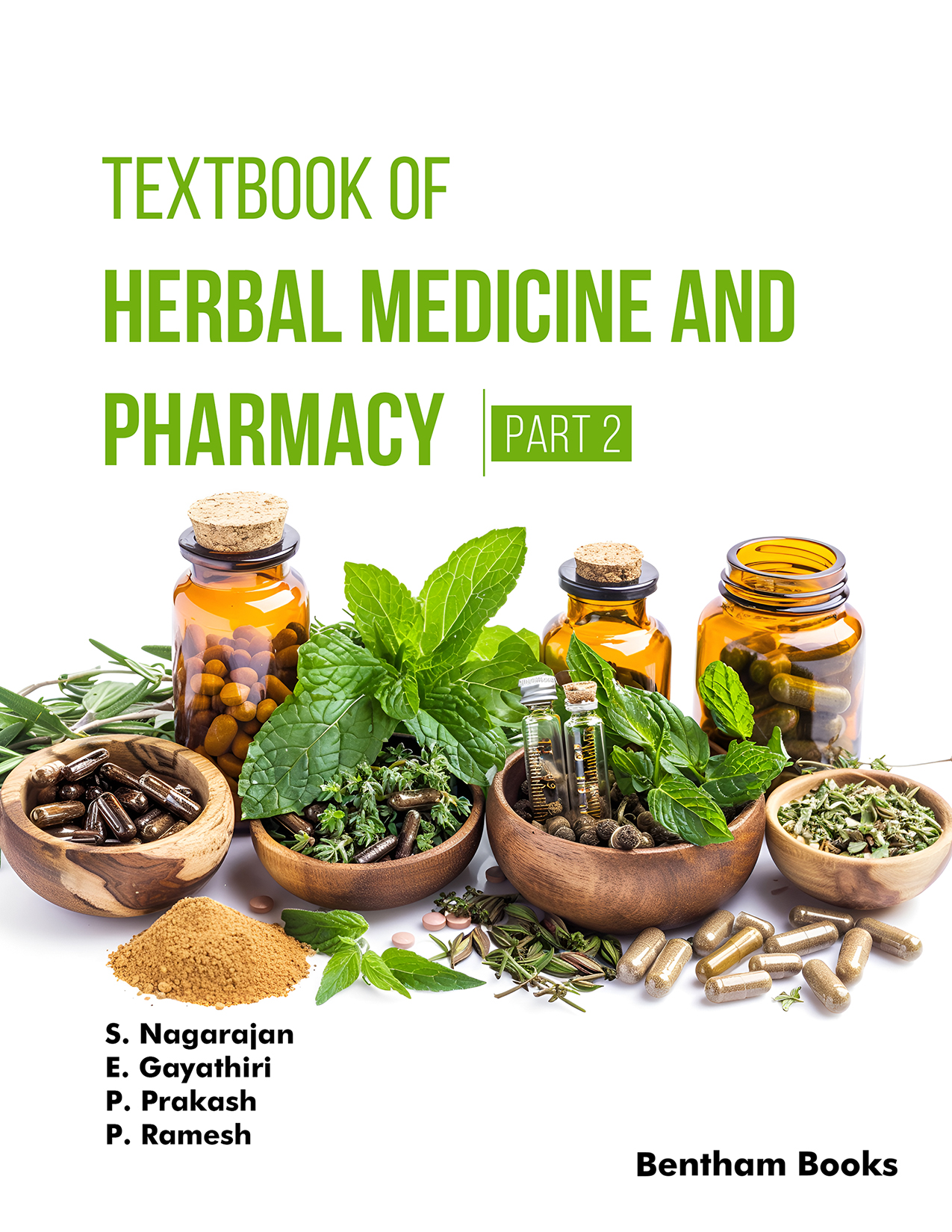
Textbook of Herbal Medicine and Pharmacy (Part 2)

Authors: S. Nagarajan, E. Gayathiri, P. Prakash, P. Ramesh

Textbook of Herbal Medicine and Pharmacy (Part 2)

ISBN: 979-8-89881-634-6
eISBN: 979-8-89881-633-9 (Online)

Introduction

Textbook of Herbal Medicine and Pharmacy is a comprehensive two-part resource that connects traditional knowledge of medicinal plants with modern scientific principles and pharmaceutical applications. Designed primarily for students, the textbook provides a structured understanding of herbal medicine fundamentals and contemporary technologies used in therapeutic development.


Key Features

  • - Understand the fundamental principles and scope of herbal medicine and pharmacy.
  • - Connect traditional medicinal knowledge with modern scientific approaches.
  • - Learn about the cultivation, processing and value addition of medicinal plants.
  • - Learn about the methods of Identifying, evaluating and screening bioactive compounds.
  • - Explore herbal drug formulation, dosage forms and pharmaceutical applications.
  • - Discover emerging approaches, including network pharmacology, artificial intelligence, and computational drug discovery.

Part 2 explains the scientific evaluation and pharmaceutical development of herbal medicines. Chapters cover the classification of secondary metabolites, identification of bioactive components, and the use of bioassays and pharmacological screening to assess therapeutic potential. The volume also discusses the formulation and dosage forms of herbal drugs. Finally, it introduces network pharmacology, artificial intelligence, and computational drug discovery as emerging approaches for understanding and developing herbal medicines.


Readership :

Students in pharmacy, pharmacology, medicinal chemistry and herbal medicine courses. Trainers and educators in herbal medicine programs.

Preface

The use of herbal medicine stays an important part of healthcare systems in the world. As the topic of plant-derived therapeutics and investigations in natural products gains ground, the necessity of scientifically designed educational materials combining the traditional knowledge on herbs with the current technological and pharmaceutical developments increases.

The book, Textbook of Herbal Medicine and Pharmacy (Part 2), has been designed to offer a comprehensive knowledge of the secondary metabolites, finding the active components, the pharmacological screening, the strategies to formulate the drugs, and the new science of network pharmacology. The text is well structured in such a way that conceptual clarity, scientific accuracy, and practical relevance are made clear.

Chapter one expounds on the classification of the secondary metabolites, such as alkaloids, phenolics, terpenoids, and the rest of the bioactive compounds, in relation to their biological functions, biosynthesis, and medicinal uses. The further chapters are devoted to extraction methods, purification methods, bioassays, pharmacodynamics, quality control, and formulation science.

The peculiarity of the given book is the discussion of herbal technology and network pharmacology in detail. The changing nature of herbal drug research is captured in the combination of computational biology and machine learning with multi-omics data and systems pharmacology. The method emphasizes the transition from single-target treatment modalities to multi-target approaches to therapy.

The book targets pharmacy and pharmacognosy students, life sciences students, and others. It is also expected that it will lead to the advantage of researchers, academicians, and professionals involved in developing herbal drugs and translational research.

We are grateful to people in colleges, students, and publishing professionals, who helped to complete this work. We would like to believe that this book may encourage the readers to consider the scientific richness and therapeutic possibilities of herbal medicines.

S. Nagarajan
Department of Chemistry, National Institute of Technology Manipur
Langol, Imphal - 795004, Manipur, India

E. Gayathiri
Department of Plant Biology and Plant Biotechnology
Guru Nanak College (Autonomous), Velachery
Chennai, Tamil Nadu, India

P. Prakash
Department of Research Saveetha College of Nursing
Saveetha Institute of Medical and Technical Sciences
(SIMATS), Saveetha University, Thandalam
Chennai - 602105, Tamil Nadu, India

&

P. Ramesh
Protein Structure-Function Research Unit
School of Molecular and Cell Biology
University of the Witwatersrand, Johannesburg - 2050
South Africa