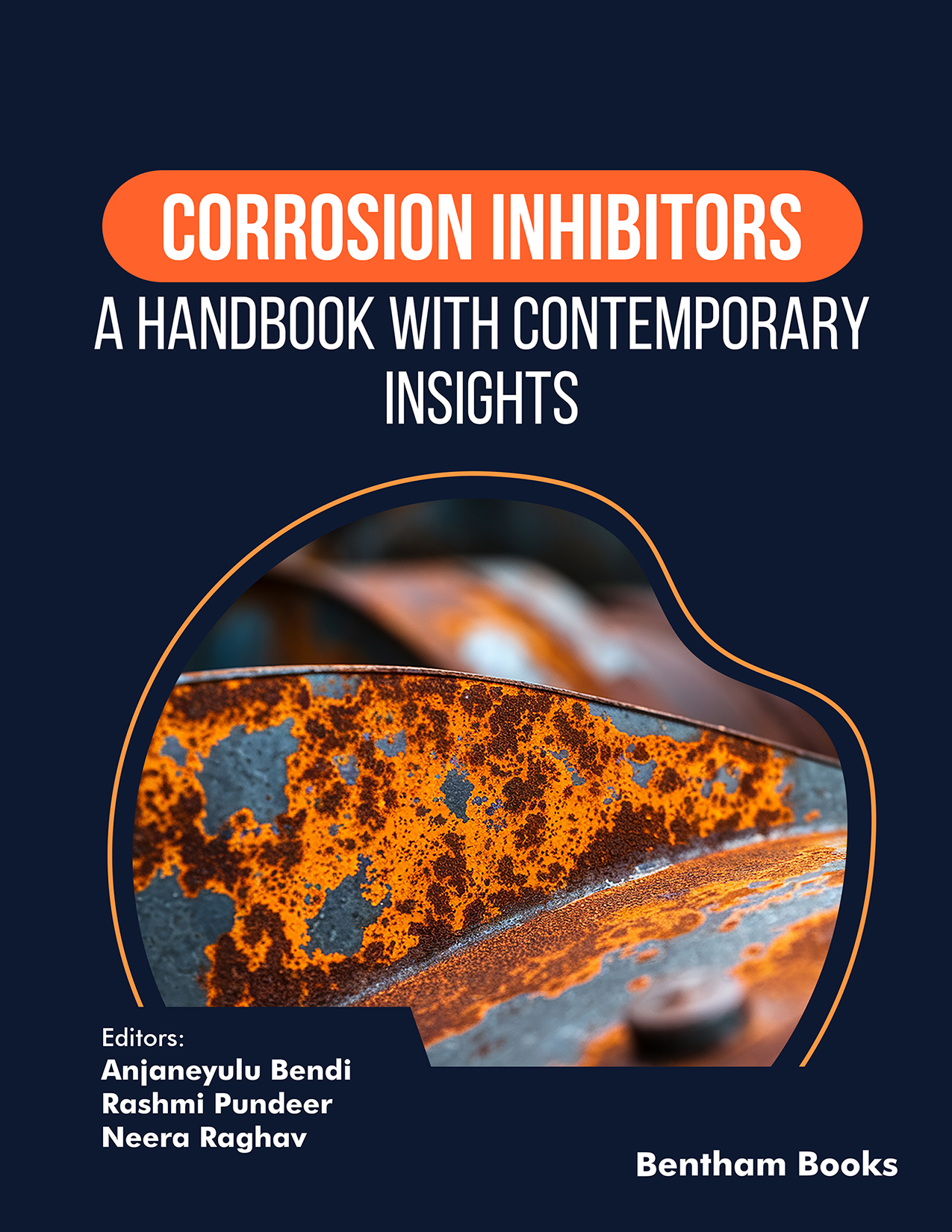
It is a great pleasure to write the foreword to Corrosion Inhibitors: A Handbook with Contemporary Insights edited by Dr. Anjaneyulu Bendi, Prof. (Dr.) Rashmi Pundeer, and Prof. (Dr.) Neera Raghav. The editors are excellent scientists with a broad experience in many fields of chemistry. Their intellectual accomplishments, depth of experience, and continuous devotion to scientific progress have gained them tremendous recognition and esteem in the academic and research communities.
Corrosion is a major and costly problem for contemporary industries, impacting the lifetime, safety, dependability, and economic viability of materials and infrastructure. Hence, the search for new, efficient, and environmentally benign corrosion inhibitors has become increasingly important in fundamental research and practical applications. The selectivity and efficiency of the inhibitors are especially important for the success of corrosion-control schemes for different materials and diverse operating situations.
Recent developments in chemistry, materials science, and surface engineering have profoundly changed our approach to corrosion protection. New technologies, such as nanotechnology, smart and sensitive coatings, and sophisticated molecular design, along with modern synthetic techniques, have opened new avenues for the development of highly efficient and sustainable protection systems. Such improvements allow for more accurate control of corrosion processes and the design of materials and coatings with improved durability, usefulness, and environmental compatibility.
Against this continuously expanding scientific backdrop, Corrosion Inhibitors: A Handbook with Contemporary Insights presents a timely and thorough overview of current advances in corrosion science and inhibition technology. The book integrates up-to-date knowledge and new insights, with specific focus on molecular and technical advancements that are transforming the field of material protection. Its chapters address the potential of new corrosion inhibitors and innovative protective techniques, focusing on their ability to deliver solutions that are more efficient, long-lasting, cost-effective, and environmentally friendly.
The importance of this volume extends beyond a mere record of current scientific advances. The development of improved corrosion-control technology is becoming increasingly important in light of global concerns, such as sustainability, resource efficiency, infrastructure durability, and environmental responsibility. This book bridges fundamental scientific understanding with emerging technical approaches to offer useful insights for addressing corrosion-related challenges across a broad range of industrial applications.
I am confident that Corrosion Inhibitors: A Handbook with Contemporary Insights will be a valuable source of information for researchers, academicians, students, industry professionals, engineers, and policymakers working in the fields of corrosion science, materials chemistry, surface engineering, and related disciplines. I further believe that the viewpoints discussed in this volume will offer fertile ground for new ideas, foster multidisciplinary research, and contribute substantially to the development of next-generation sustainable corrosion-protection systems.
I applaud the editors and contributing authors on this essential and timely publication. I do hope that this book will earn the recognition it deserves in the scientific and professional communities and will be an inspiration for further studies and innovations in the important field of corrosion prevention and material protection.
Saviour A. Umoren
Interdisciplinary Research Center for Advanced Materials
King Fahd University of Petroleum and Minerals
Dhahran, Saudi Arabia