
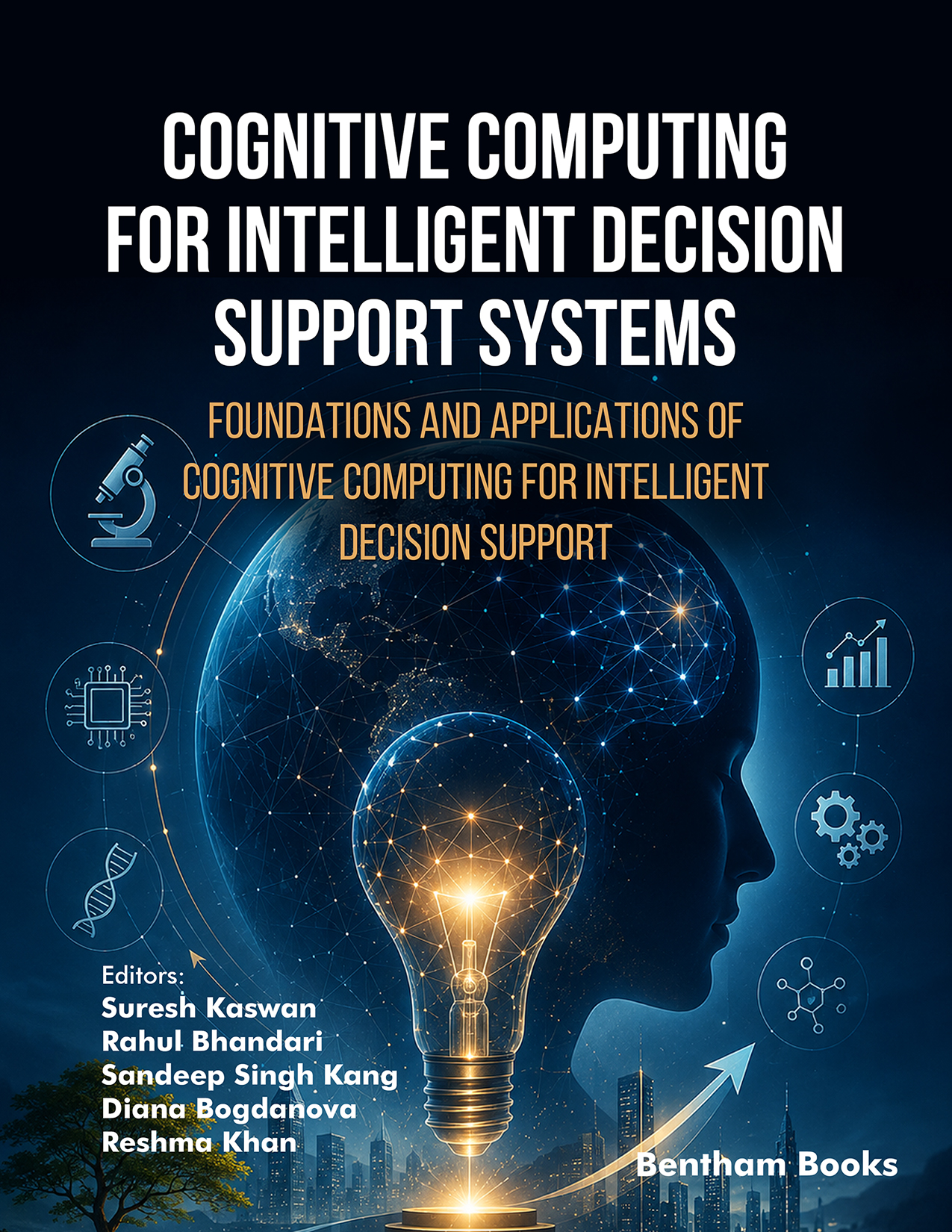
Cognitive Computing for Intelligent Decision Support Systems: Foundations and Applications of Cognitive Computing for Intelligent Decision Support

Editors: Suresh Kaswan, Rahul Bhandari, Sandeep Singh Kang, Diana Bogdanova, Reshma Khan

Cognitive Computing for Intelligent Decision Support Systems: Foundations and Applications of Cognitive Computing for Intelligent Decision Support

ISBN: 979-8-89881-796-1
eISBN: 979-8-89881-795-4 (Online)

Introduction

This book offers a contemporary and interdisciplinary perspective on the technologies shaping the next generation of intelligent decision-making. The volume features thirteen chapters that collectively explore how cognitive computing can bring together advanced technologies – like artificial intelligence, and blockchain networks – to improve healthcare, cybersecurity and human digital experiences. Rather than examining these areas in isolation, the book highlights their growing interconnection and their collective potential to create systems that are smarter, more adaptive, secure, responsive and centered on human needs.

The chapters take readers through a wide range of topics, beginning with the possibilities of 6G communication in a hyperconnected world and the growing relevance of emotional and digital intelligence. The discussion then moves into AI-enabled cybersecurity, quantum approaches to intelligent decision support, and privacy and security issues in blockchain-based supply chains. Further chapters examine augmented reality and gamification, data compression techniques, IoT-supported remote patient monitoring, and the integration of emotional and digital intelligence with fractional calculus. The book also addresses privacy-preserving multimodal biometric authentication, hybrid blockchain frameworks, the expanding role of IoT in healthcare, AI-based early detection of brain tumors, environmentally sustainable data centers, and personalized multimodal content based on emotional patient profiles. Together, these contributions provide a broad picture of how intelligent technologies are influencing critical sectors and redefining the way complex decisions are supported.


Key Features

  • - 13 edited chapters providing an integrated perspective of cognitive computing and associated technologies.
  • - Covers important issues such as security, privacy, sustainability, accuracy, and user-centered design.
  • - Bridges fundamental computing concepts with practical applications.

Target Readership :

Primary: Scholars and advanced learners seeking an integrated understanding of cognitive and intelligent technologies.

Secondary: industry professionals, healthcare researchers, and decision-makers interested in the future development and practical application of cognitive computing for digital ecosystems.

Foreword

It is with immense pride and enthusiasm that I present the foreword to the edited book titled "Cognitive Computing for Intelligent Decision Support Systems." In an era marked by rapid technological advancement and increasing reliance on intelligent systems, this book emerges as a timely and valuable contribution to both academia and industry.

The convergence of Artificial Intelligence, Machine Learning, IoT, and cognitive computing is transforming the way decisions are made across domains—ranging from cybersecurity and healthcare to digital governance and supply chain systems. This book delves into these multidisciplinary intersections, exploring not only the technical innovations but also the societal implications of these emerging technologies. Topics such as biometric authentication, 6G communication, serverless architectures, and blockchain-driven data transparency are discussed with scholarly depth and real-world relevance.

Our aim with this volume is to provide a comprehensive platform for researchers, academicians, and professionals to share their insights and advancements in the field of intelligent decision support systems. The diverse range of themes—from mental health technologies and cybersecurity challenges to green data centers and subscription-based digital content models—reflects the breadth and complexity of the modern digital ecosystem.

I would like to extend my sincere gratitude to all contributing authors, peer reviewers, and our editorial team, whose efforts and expertise have made this book possible. A special thanks to Bentham Science for their support in disseminating this knowledge to a global readership, and to Chandigarh University for fostering a culture of innovation and research excellence.

I am confident that this book will serve as a foundational reference and inspire future research in the evolving landscape of cognitive computing.

Warm regards,

Manpreet Singh Manna
Vice Chancellor
Chandigarh University, Mohali
Punjab, India