
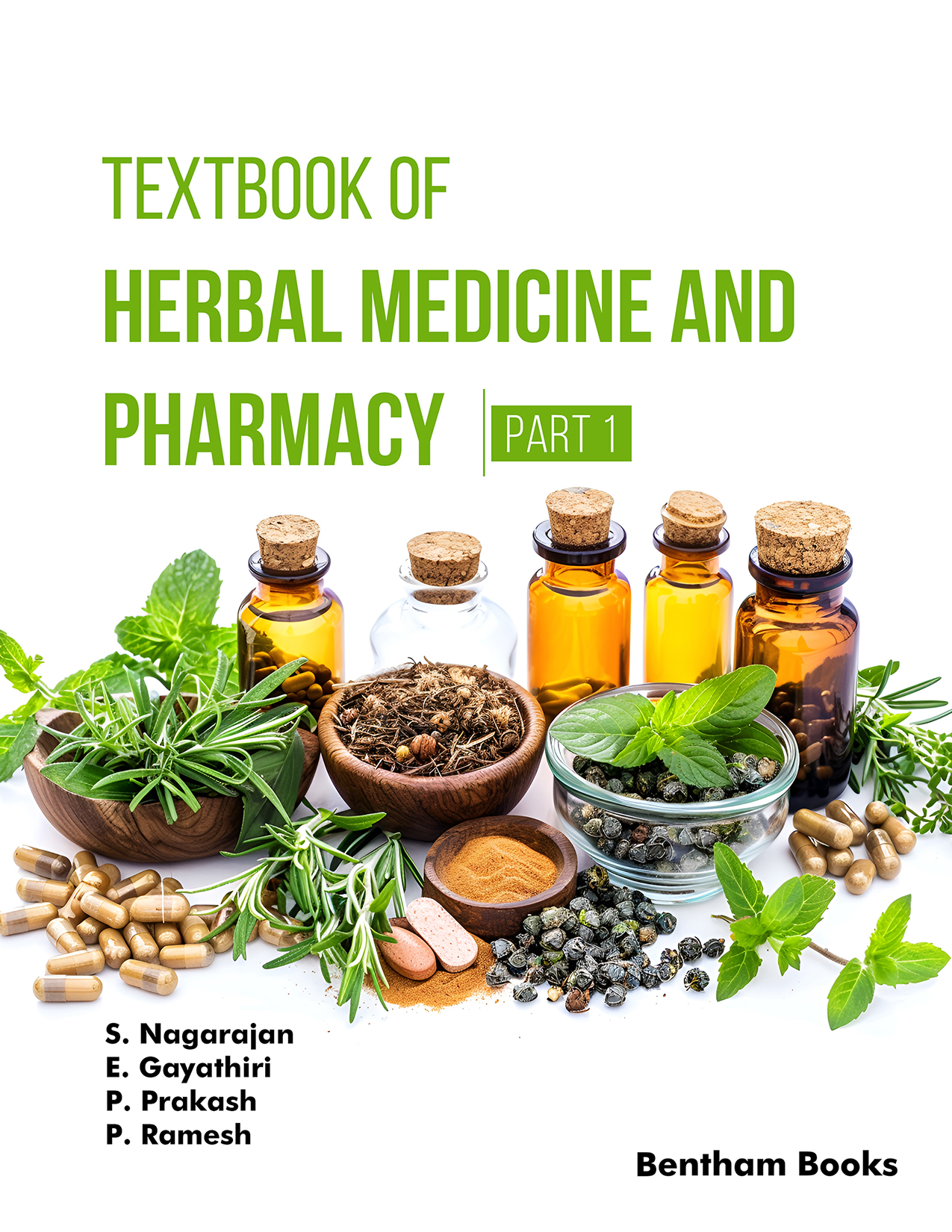
Authors: S. Nagarajan, E. Gayathiri, P. Prakash, P. Ramesh

Textbook of Herbal Medicine and Pharmacy (Part 1)

eBook: US $69 Special Offer (PDF + Printed Copy): US $118
Printed Copy: US $83
Library License: US $276
ISBN: 979-8-89881-631-5 (Print)
ISBN: 979-8-89881-630-8 (Online)
Year of Publication: 2026
DOI: 10.2174/97988988163081260101

Introduction

Textbook of Herbal Medicine and Pharmacy is a comprehensive two-part resource that connects traditional knowledge of medicinal plants with modern scientific principles and pharmaceutical applications. Designed primarily for students, the textbook provides a structured understanding of herbal medicine fundamentals and contemporary technologies used in therapeutic development.


The book enables readers to:

  • - Understand the fundamental principles and scope of herbal medicine and pharmacy.
  • - Connect traditional medicinal knowledge with modern scientific approaches.
  • - Learn about the cultivation, processing and value addition of medicinal plants.
  • - Learn about the methods of identifying, evaluating and screening bioactive compounds.
  • - Explore herbal drug formulation, dosage forms and pharmaceutical applications.
  • - Discover emerging approaches, including network pharmacology, artificial intelligence and computational drug discovery.

Part 1 introduces the foundations of herbal technology and the historical development of traditional and alternative medicine systems. Chapters explain the cultivation, harvesting, processing and storage of medicinal plants and herbal products, with attention to maintaining their quality and value. The volume also discusses value-added plant products and the principles of pharmacognosy, providing readers with a foundation for understanding the natural sources, characteristics and practical development of herbal medicines.

Target Readership :

Students in pharmacy, pharmacology, medicinal chemistry, and herbal medicine courses. Trainers and educators in herbal medicine programs.

Foreword

Herbal medicine has been an essential part of human civilization for centuries, forming the foundation of traditional healing systems across cultures. Today, with remarkable advancements in pharmaceutical science, these ancient remedies are being redefined through rigorous chemical and pharmacological research. This book serves as a crucial bridge between tradition and innovation, offering students, researchers, and professionals an in-depth exploration of herbal cultivation and multi-target drug discovery. By seamlessly integrating historical wisdom with modern scientific approaches, it opens new frontiers in integrative medicine, fostering groundbreaking advancements in healthcare and therapeutics. I deeply admire the complex chemical makeup of medicinal plants because they contain secondary metabolites and bioactive compounds, which provide potential medical applications for modern therapy. This collection provides readers with an organised intellectual adventure between classical herbal treatment studies and the future evolution of network pharmacology.

The authors drew upon knowledge from multiple fields to create a one-of-a-kind handbook that serves as a practical resource for individuals seeking to learn about drug discovery, herbal medicine, and pharmacognosy. The book will generate interest in plant-based treatments among both trainee researchers and experienced professionals.

I extend my sincere regard to all contributors and readers, with the hope that this publication will contribute to the advancement of herbal science and pharmaceutical research.

R. Karvembu
Department of Chemistry
National Institute of Technology
Trichy-620 015
India