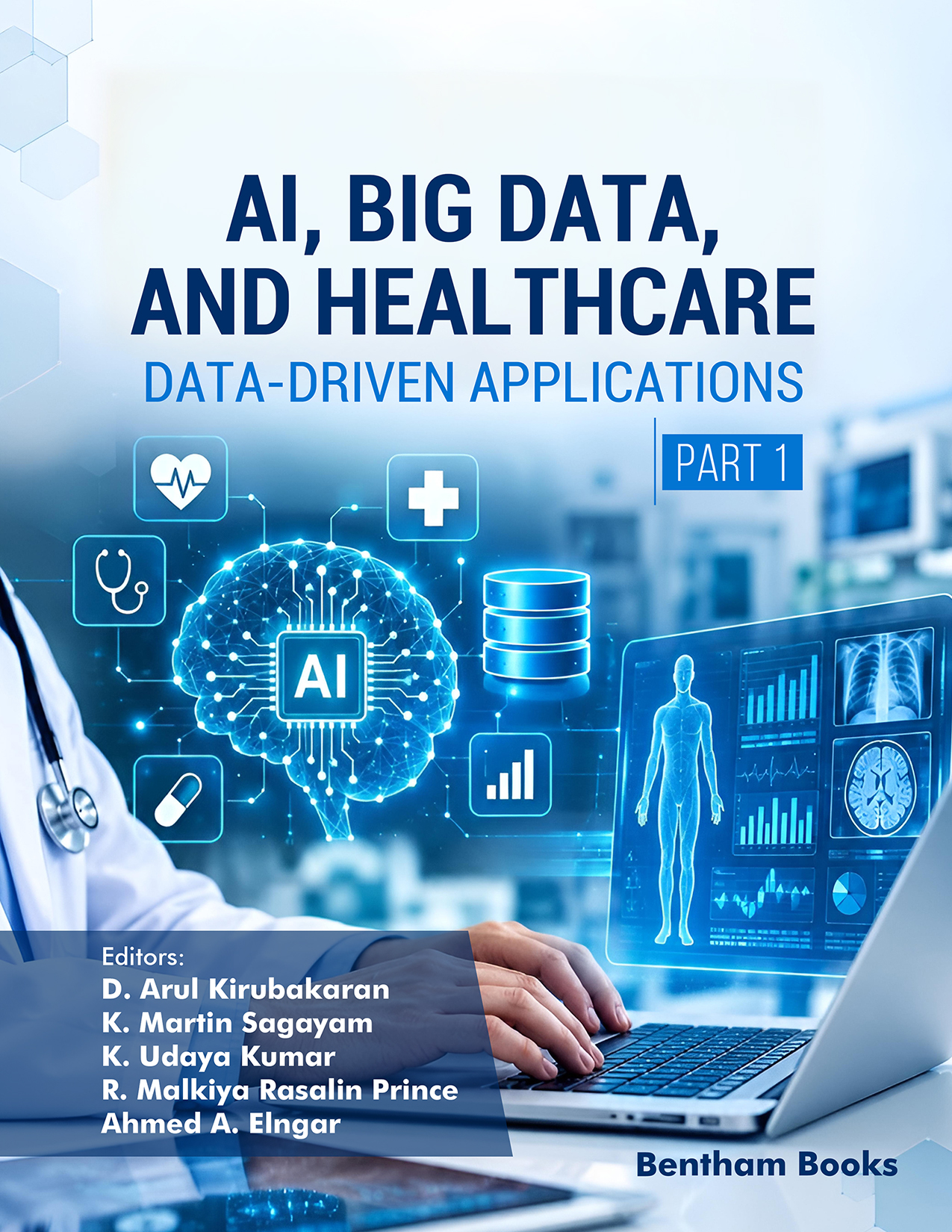
In the era of digital transformation, the integration of Artificial Intelligence (AI), Big Data, and Industry 4.0 technologies signifies more than a technological evolution—it marks a profound scientific revolution that is reshaping how we understand, engage with, and address complex real-world challenges. This transformation is particularly significant in sectors such as healthcare and manufacturing, where data-driven intelligence and automation are redefining the benchmarks of service delivery and production efficiency.
The book “AI, Big Data, and Healthcare Data-Driven Applications” provides a comprehensive and timely examination of these emerging domains. From a scientific standpoint, it compiles carefully selected research contributions that highlight the growing interplay between advanced computational methods and domain-specific problem-solving. Each chapter reflects how the integration of scientific rigor with technological innovation can drive advancements in diagnostics, predictive analytics, and operational performance.
The convergence of AI and Big Data analytics offers a robust framework for uncovering intricate patterns and relationships within complex datasets. This capability enables early disease detection, precision medicine, and personalized healthcare solutions. These advancements are supported by developments in machine learning, deep learning, and natural language processing, which are increasingly achieving performance levels comparable to human expertise in clinical diagnostics and decision support systems.
Simultaneously, Industry 4.0 and the Industrial Internet of Things (IIoT) are revolutionizing traditional manufacturing by enabling intelligent, adaptive, and interconnected systems. Through real-time data acquisition and AI-driven decision-making, these technologies enhance operational efficiency, optimize resource utilization, and improve product quality, thereby advancing the transition toward autonomous manufacturing ecosystems.
The book addresses several key scientific themes, including predictive and descriptive analytics in healthcare, AI-driven diabetes prediction models, deep learning applications in medical imaging, IoT-enabled health monitoring systems, and analytical approaches to biotechnology security. It also examines the evolution of digital healthcare initiatives in India, the role of AI in mental health assessment, and the application of smart manufacturing and IIoT within modern industrial frameworks.
More than a conventional reference, this volume serves as a strategic guide for researchers, practitioners, and policymakers navigating the rapidly evolving landscape of data-centric technologies. By bridging disciplines such as computer science, healthcare, biotechnology, and industrial engineering, it promotes an integrated perspective on the transformative potential of AI and Big Data.
In addressing global challenges that demand intelligent, efficient, and reliable solutions, this book aims to foster innovation, collaboration, and critical thinking. It underscores the importance of collective scientific effort in advancing the capabilities of AI for societal benefit and shaping a more informed and technologically empowered future.
Tapas Debnath
Central Manufacturing Technology Institute
Ministry of Heavy Industries
Govt of India, India