
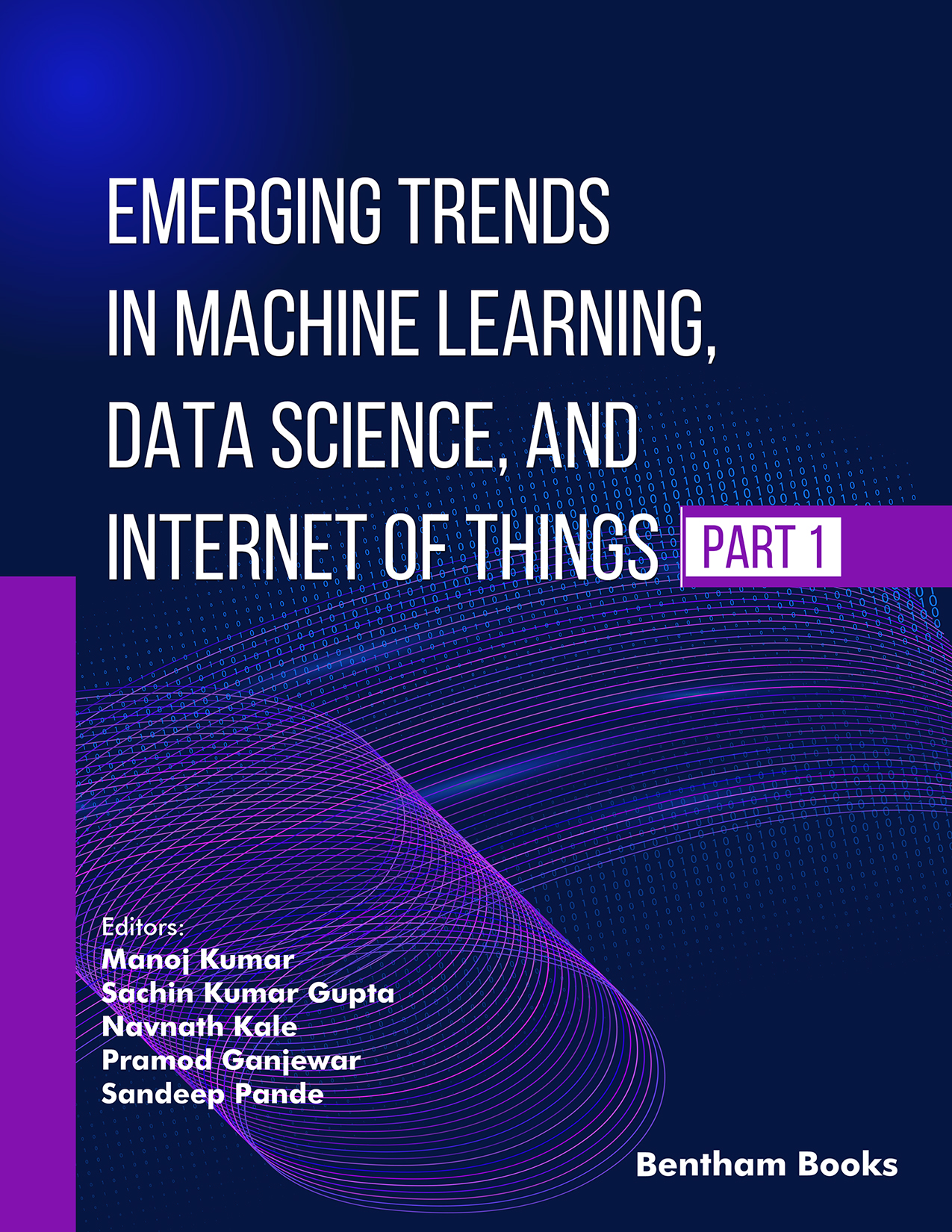
Editors: Manoj Kumar, Sachin Kumar Gupta, Navnath Kale, Pramod Ganjewar, Sandeep Pande

Emerging Trends in Machine Learning, Data Science, and Internet of Things (Part 1)

eBook: US $89 Special Offer (PDF + Printed Copy): US $143
Printed Copy: US $98
Library License: US $356
ISBN: 979-8-89881-472-4 (Print)
ISBN: 979-8-89881-471-7 (Online)
Year of Publication: 2026
DOI: 10.2174/97988988147171260101

Introduction

Emerging Trends in Machine Learning, Data Science, and Internet of Things Volumes 1 & 2 explores the technologies shaping the future of intelligent systems. Covering Machine Learning, Data Science, IoT, Blockchain, Cloud Computing, and Artificial Intelligence, the book focuses on designing and applying secure, data-driven solutions across healthcare, agriculture, transportation, education, cybersecurity, and digital content management.

It blends cutting-edge research with practical implementations, including AI-driven disease prediction, anomaly detection for network security, sentiment analysis, smart IoT applications, and blockchain-enabled digital authentication. The volumes highlight both theoretical foundations and real-world case studies, offering actionable insights for researchers and industry professionals alike.


Key Features

  • - Comprehensive coverage of AI, ML, IoT, and Data Science applications.
  • - Case studies on healthcare, agriculture, cybersecurity, and digital systems.
  • - Practical implementations and comparative analyses of models.
  • - Interdisciplinary insights, including AR, blockchain, and smart systems.
  • - Focuses on both theory and real-world application.

Target Readership :

Researchers, academics, postgraduate students and professionals in Computer Engineering, IT, and Data Science.

Foreword

The remarkable progress of artificial intelligence over the past decade has been driven not only by advances in algorithms, but by the creative application of these techniques to meaningful real-world problems. This volume is a compelling reflection of that progress. It brings together diverse research contributions that demonstrate how machine learning, data science, and intelligent systems are reshaping healthcare, security, automation, and human–computer interaction.

The chapters in this book highlight the expanding influence of deep learning and data-driven methodologies. From skin lesion classification and epileptic abnormality recognition to cancer gene detection and bacterial colony analysis, the healthcare-focused studies illustrate the profound societal impact that intelligent models can deliver. Equally noteworthy are the works on sentiment analysis, optimization strategies, and automated grading systems, which demonstrate the growing sophistication of computational approaches in understanding human language and behavior.

The inclusion of research on early-stage fire detection, AI-powered anomaly detection for cyber security, and conflict resolution in self-driving vehicles underscores the importance of reliable and trustworthy AI systems. These contributions reflect a strong awareness of the need for robustness, safety, and privacy in modern technological ecosystems. The chapters on IoT-enabled cloud security further emphasize that intelligent systems must be both innovative and secure.

What distinguishes this volume is its balanced integration of theory and application. The contributors not only explore advanced computational models but also present practical implementations that address pressing global challenges. Such interdisciplinary engagement is essential for the continued evolution of artificial intelligence.

I commend the editors and authors for assembling a work that captures the dynamic spirit of contemporary research in intelligent computing. This book will serve as a valuable resource for researchers, practitioners, and students seeking to contribute to the next generation of AI-driven solutions.

K. V. D. Kiran
Department of Computer Science and Engineering
Koneru Lakshmaiah Education Foundation
Guntur District, India