
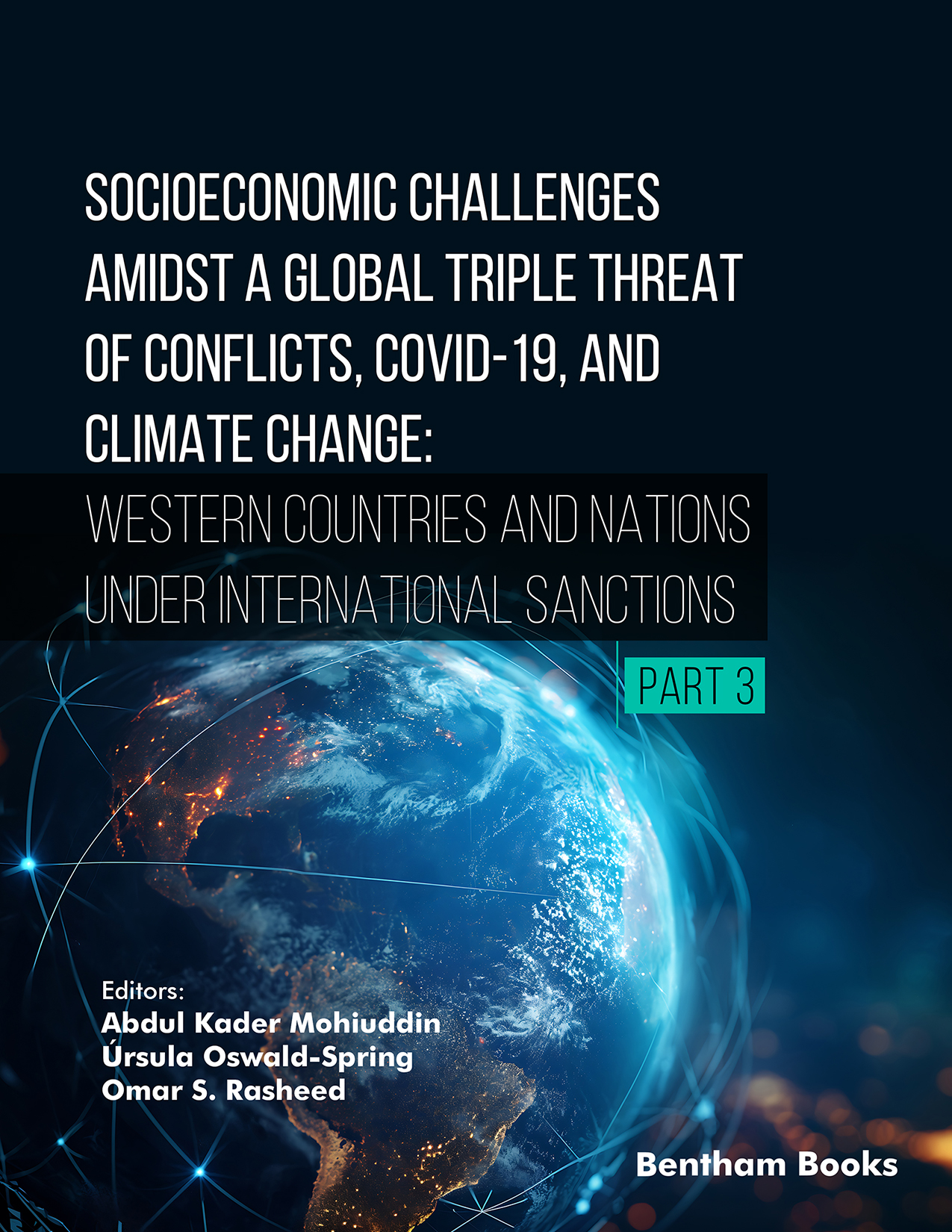
Editors: Abdul Kader Mohiuddin, Úrsula Oswald -Spring, Omar S. Rasheed

Socioeconomic Challenges Amidst a Global Triple Threat of Conflicts, COVID-19, and Climate Change: Western Countries and Nations Under International Sanctions (Part 3)

eBook: US $99 Special Offer (PDF + Printed Copy): US $179
Printed Copy: US $129
Library License: US $396
ISBN: 979-8-89881-466-3 (Print)
ISBN: 979-8-89881-465-6 (Online)
Year of Publication: 2026
DOI: 10.2174/97988988146561260101

Introduction

The book explores the evolving global socioeconomic crisis shaped by the convergence of the COVID-19 pandemic, persistent cross-border and internal conflicts, international sanctions and recurring natural disasters. Situated within the broader field of global political economy and development studies, it examines how these overlapping shocks disrupt economic systems, trade and energy pathways and essential sectors such as healthcare, agriculture, education and communication. The central theme emphasizes the interconnected and mutually reinforcing nature of these crises, highlighting how structural vulnerabilities and human-driven factors intensify their scale and impact across both developed and developing regions.

A key strength of the book lies in its integrative, multidisciplinary approach, combining economic analysis with political and environmental perspectives. It offers structured and timely insights into developments across several regions and presents a human-centered narrative that consistently foregrounds the lived experiences of ordinary people, especially in war-torn and vulnerable societies.

The chapters collectively trace the progression of these crises across regions and sectors. Early sections examine the pandemic's economic and social aftermath, followed by analyses of major conflict zones—including Ukraine and the Middle East—and their far-reaching implications for global supply chains, food security and energy markets. Subsequent chapters explore the role of sanctions, climate stress and geopolitical tensions, particularly the ripple effects of U.S.–China rivalry, in reshaping global stability. Together, they reveal how strategic chokepoints such as the Strait of Hormuz and the Red Sea have become critical pressure points in an increasingly fragile global system.

Part 3 covers conditions in Western Developed regions (focusing on United States of America and Europe) and two countries under international trade sanctions (Iran and Russia).>


Key Features

  • - Integrates real-world evidence with clinical trial data.
  • - Covers major spine surgery domains and technologies.
  • - Comparative analysis of evidence vs. surgeon experience.
  • - Uses structured survey data and Rasch-based methodology to provide practical insights for clinical decision-making and research.

Target Readership :

Primary readership: Researchers studying war and conflict, public health, epidemiology, international affairs, peace and conflict studies and health economics; diplomats, policy and development analysts and humanitarian workers.

Secondary readership: Students of sociology, economics, political science, international relations, development studies, environmental studies and global health; journalists, educators and general readers.

Preface

This book emerges at a moment when the global order is being reshaped by overlapping crises that no nation can fully escape. Over the past two decades, Western sanctions on countries such as Iran and Russia have intensified geopolitical divisions, disrupting financial systems, energy flows, and global trade while accelerating the rise of alternative economic alliances beyond Western control. At the same time, the economic centers of the United Kingdom, United States, and wider Europe are confronting their own internal strains, shaped by the lingering effects of the pandemic, energy shocks linked to the Ukraine war, and mounting inflationary pressures. Brexit, political instability, and a deepening cost-of-living crisis have tested the resilience of British institutions, while across Europe sluggish growth, energy insecurity, and rising poverty risks signal structural vulnerabilities beneath its developed status. In the United States, escalating national debt, persistent political polarization, and continuous global military engagements reflect a superpower under mounting fiscal and social pressure. Meanwhile, sanctions have not only constrained Iran and Russia but also driven them to adapt, forging new partnerships, parallel financial systems, and alternative energy markets that challenge long-standing Western dominance. These shifts have contributed to global market fragmentation, volatile energy prices, and supply chain disruptions that reverberate across all economies. Compounding these pressures, climate change is intensifying extreme weather, undermining infrastructure, agriculture, and long-term development prospects, while slowing progress toward sustainability goals. The aftershocks of COVID-19 continue to strain healthcare systems, labor markets, and social safety nets, exposing deep inequalities within and between nations. Across both sanctioned and sanctioning countries, rising food insecurity, housing crises, and public discontent reveal the human cost of these converging disruptions. What emerges is a world no longer defined by stable economic hierarchies, but by uncertainty, adaptation, and shifting power balances. This volume seeks to explore these intertwined crises, offering a critical examination of how conflict, policy, and environmental change are collectively reshaping the socio-economic future of nations in an increasingly fragmented global landscape.

Abdul Kader Mohiuddin
Alumnus, Faculty of Pharmacy
Dhaka University, Dhaka, Bangladesh

Úrsula Oswald-Spring
Regional Multidisciplinary Research Center
National University of Mexico
Mexico city, Mexico

&

Omar S. Rasheed
University of Almería, Carretera Sacramento
S/N, La Cañada de San Urbano, 04120
Almería, Spain