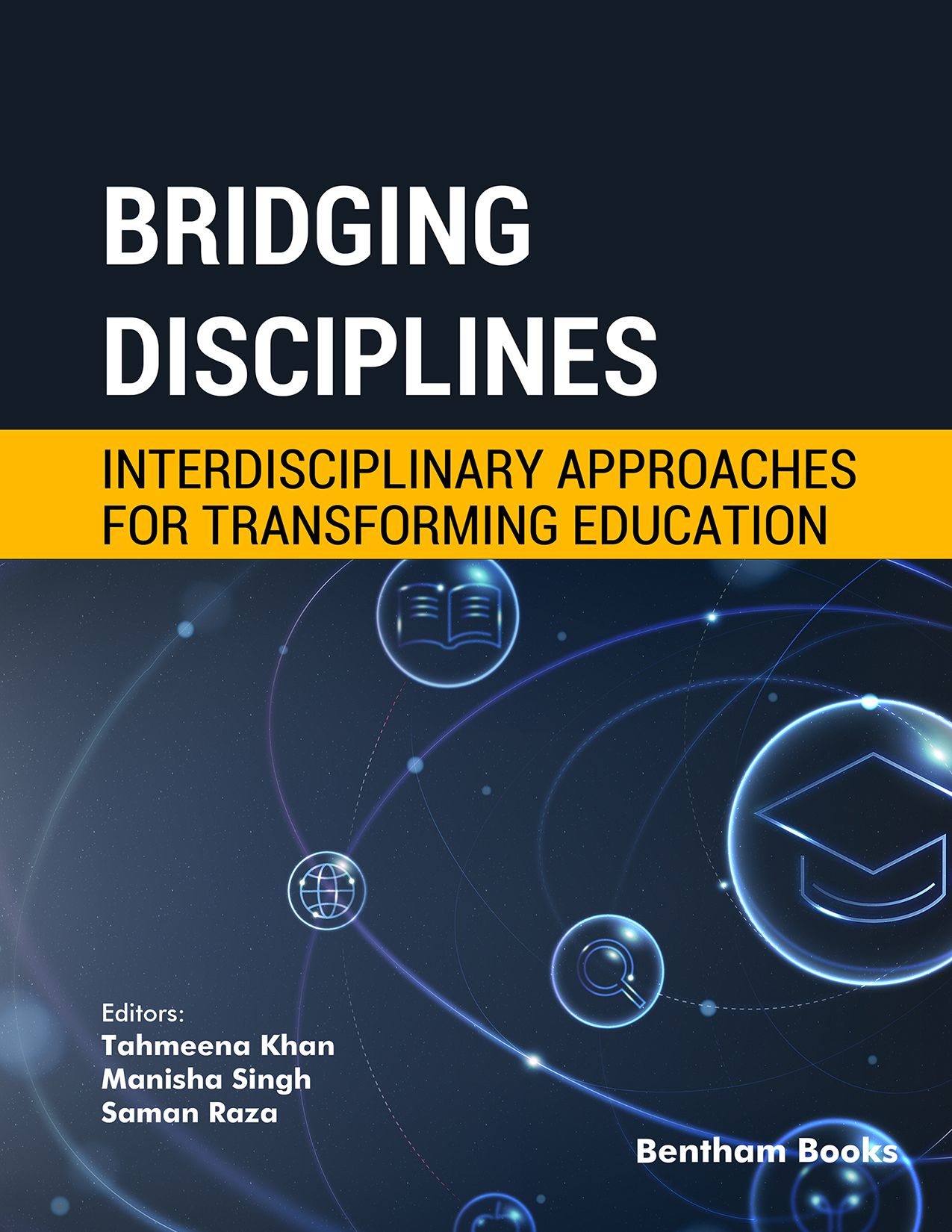
In a world that is ever-changing and increasingly complex, a field such as education, which encompasses various disciplines, must work to prepare students to understand the connections between this complex world and to meet the uncertain demands of the future, as well as the pressing issues of the present. There is no doubt that traditional discipline-specific teaching methods are the foundation of the education system, but they are unable to meet the changing demands of today's education. There is a need for an approach that fosters connections between various disciplines and equips students with adaptable abilities, integrative thinking, and a collaborative mindset, essential for addressing today's world and its complexities. One such approach that may fulfil this need is addressed in this book titled " Bridging Disciplines: Interdisciplinary Approaches for Transforming Education." The book is a compilation of 14 chapters from contributions by different experts in their respective areas and therefore offers a rich account of insights, new frontiers, and interdisciplinarity across disciplines. Each chapter is constructed to be self-contained, allowing readers to dive in and out as their understanding permits.
The book begins with an introduction to interdisciplinarity in education, where the chapter presents various related concepts, including interdisciplinary, multidisciplinary, and bridging disciplines, to enable readers to achieve a clear conceptual understanding upon completing this chapter. The second chapter, Bridging the Barrier Between Science and Arts, aims to reduce the gap between the two major categories of disciplines, viz., science and arts. The third chapter discusses various pedagogical strategies for Interdisciplinary Learning in a general domain. The subsequent chapters cover a broad spectrum of topics, written in a way that each chapter draws upon insights from various fields, including the STEAM paradigm, Commerce, Social Studies, Languages, Biological Science, Chemical Science, Mathematics, Environmental Science, and Architectural Studies. The last two chapters provide insight into creativity and AI tools in interdisciplinary research.
The revolutionary potential of interdisciplinary approaches in education is explored in this book, which advocates for instructional models that break down silos, foster holistic understanding, and stimulate creativity by integrating multiple fields of knowledge. All the chapters are presented herein with the objective of rethinking curriculum, pedagogy, and learning methodologies.
We aim to provide a comprehensive account of insights to the major stakeholders in the field of education, including educators, researchers, policymakers, and students, while promoting interdisciplinarity. Our vision for this book is to empower stakeholders with an education that is both meaningful and skilful, capable of standing up to global competition. This book would be helpful for students, teachers, researchers, and academicians who seek to integrate across different disciplines.
We anticipate that educators, researchers, policymakers, and students will find inspiration and practical guidance within these pages. As we go towards more inclusive, adaptable, and future-oriented educational settings, may this book function as both a resource and a stimulus for continuous experimentation and discourse.
As the editors of this book, we would like to thank the contributing authors for their time and expertise. We also want to thank the readers whose curiosity and commitment to advancing education through technology drive our ongoing investigation of this fascinating intersection.
Tahmeena Khan
Department of Chemistry, Integral University
Lucknow, Uttar Pradesh 226026, India
Manisha Singh
Department of Education, Integral University
Lucknow, Uttar Pradesh 226026, India
&
Saman Raza
Department of Chemistry, Isabella Thoburn College
Lucknow, Uttar Pradesh 226007, India