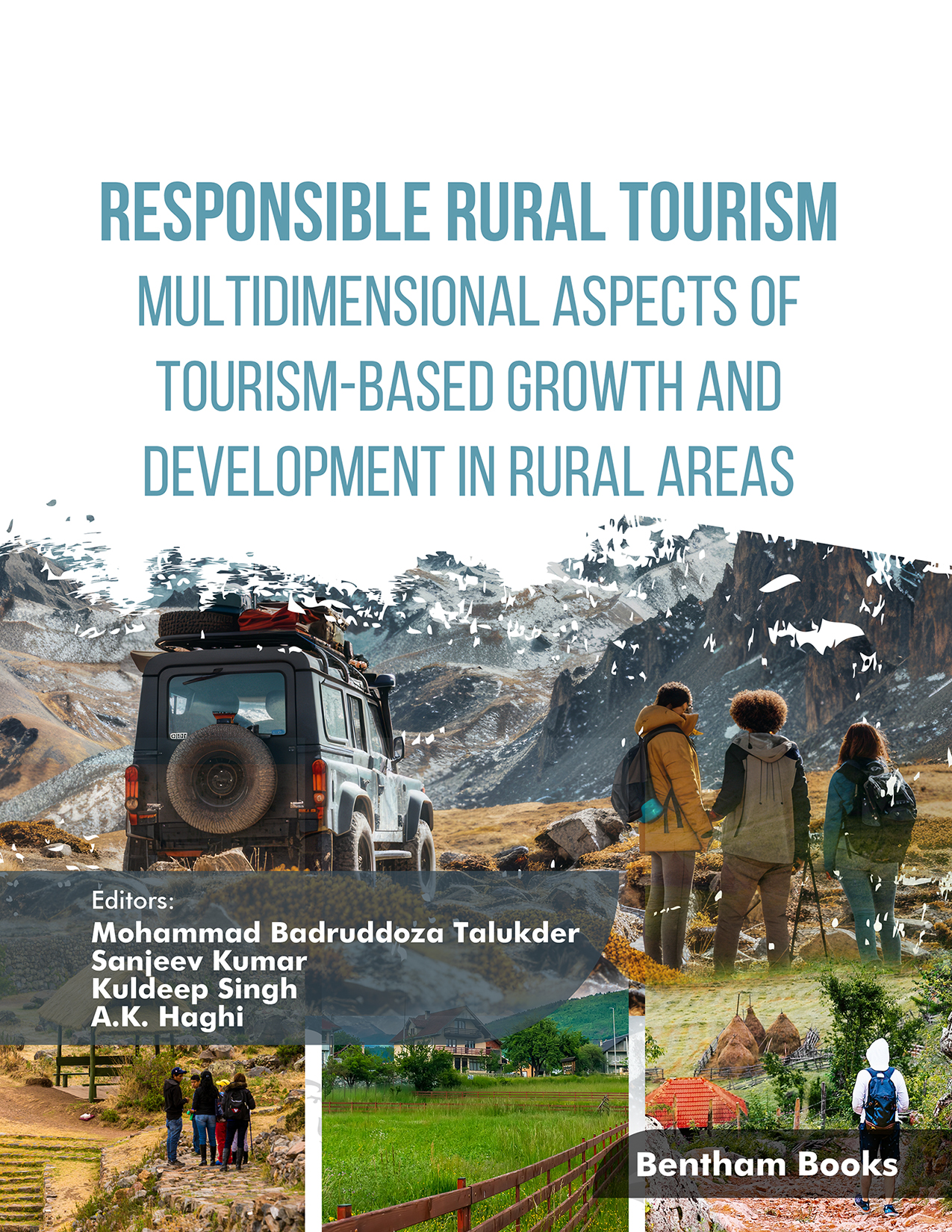
Responsible tourism is a very new approach that ensures that local communities have a fair share of benefits in developing tourism and offers an array of possibilities for tourists, offering a place to refresh, recharge, and re-awaken with the power of nature. It aims to create better tourism destinations, provide a more enjoyable experience, and attract visitors with its scenic beauty, sports attractions, and rich cultural heritage. Responsible tourism represents income and economic opportunities for remote rural communities. This book, Responsible Rural Tourism: Multidimensional Aspects of Tourism-Based Growth and Development in Rural Areas, the first of its kind, contributes to advancing research on multidimensional, responsible rural tourism. It presents a conceptual framework for understanding rural tourism from a new perspective, empirically clarifies the specific issues and constraints for the development of responsible rural tourism, and investigates how to overcome these issues.
This book comprehensively explores responsible tourism and environmental stability, catering to a diverse audience that includes students and budding engineers as well as seasoned professionals in environmental science and rural tourism. It delves into various crucial topics, each meticulously crafted to provide valuable insights into the complex issue of responsible rural tourism and environmental stability. By contributing to the local economy, respecting the customs and traditions, and protecting the environment, responsible tourists can affect the villagers’ quality of life. This book presents the fundamentals of responsible rural tourism and examines both successful and failed attempts to develop it.
This book—the first of its kind—contributes to the advancement of research on “multidimensional responsible rural tourism,” which represents a conceptual framework for understanding rural tourism from a new and unique perspective. It empirically clarifies the specific issues and constraints for the development of “Responsible Rural Tourism” and also investigates how to overcome these issues. We are deeply grateful to the contributors, researchers, and industry practitioners who have shared their insights and experiences to enrich this book. Their expertise has been instrumental in making this a comprehensive resource on “Responsible Rural Tourism”.
Chapter 1: Transforming Rural Landscapes: The Role of Farm Tourism in Haryana's Socio-Economic Development
Haryana, known as the "Land of Farmers," is a pioneering state in farm tourism in India. At various points in time over the years, various aspects of life in Haryana—the social and cultural- have become important tourist attractions, and, nowadays, agri-tourism is considered a major sector. Haryana, being an agriculture leader, formally announced the Farm Tourism scheme on World Tourism Day on 27th September 2003. This scheme is based on a public-private partnership model aimed at promoting rural culture and agriculture practices. The government amended this scheme in 2024 for strengthening farm tourism by introducing modern facilities, agri practices, cooked food, accommodation facilities, and culture performances, etc. This paper is an attempt to explore the social and economic impacts of the farm tourism sector in the state of Haryana.
Chapter 2: Responsible Tourism in Vettaikaranpudur, Tamil Nadu – A Case Study on Rural Tourism Destination
The post-pandemic has resulted in a growing interest, particularly in rural destinations where nature, culture, and heritage are not being affected by traditional mass tourism activity. Realising the necessity of responsible tourism, researchers have considered one such rural tourism village: Vettaikaranpudur, recently awarded as the Best Tourism Village by the Government of India (GoI), has been selected as the study area to explore the viability and implementation of responsible practices for sustainable development.
Chapter 3: Navigating Challenges: The Role of Psychological Ownership in Tourism Entrepreneurship Intentions among Rural Youth
Rooted in the transformative potential of rural tourism entrepreneurship, the research underscores its critical role in fostering economic growth, cultural preservation, and community empowerment. Psychological ownership, characterized by an emotional attachment and sense of possession toward local resources, emerges as a key motivator of entrepreneurial behavior. However, rural entrepreneurs face systemic barriers, including limited access to financial resources, skill deficits, and bureaucratic inefficiencies, which hinder their participation and success. This research investigates the dual role of psychological ownership as both a motivator and mediator in navigating these challenges. Drawing on a combination of psychological and structural factors, the study aims to validate the relationship between psychological ownership and tourism entrepreneurship intention, assess the influence of entrepreneurial challenges, and analyze the mediating role of psychological ownership in this interplay.
Chapter 4: Kerala’s Responsible Tourism Model: A Blueprint for Sustainable Rural Tourism Development Across Indian States
The Kerala Responsible Tourism Mission (KRTM) Society, which involves local people, preserves cultural heritage, and promotes economic growth, has become a pioneering effort in the promotion of sustainable tourism in rural destinations. The chapter examines the success story of the society and highlights some of its primary tactics, such as eco-friendly operations, community-based tourism, and skill-development initiatives that have empowered local stakeholders in the rural areas. The chapter assesses the observable social, economic, and environmental advantages produced by the Responsible Tourism concept by looking at case studies from different rural destinations in Kerala.
Chapter 5: Evaluating the Key Determinants of Responsible Rural Tourism
This study investigates the main factors influencing responsible rural tourism in the well-known Indian rural communities of Amber and Bassi, which are close to Jaipur. Understanding the elements that affect responsible tourism in these areas is crucial for encouraging community involvement and environmental conservation, especially in light of the increased interest in sustainable tourism practices. Using a non-probability sampling technique, 200 participants—tourists, locals, and tourism operators—were chosen to provide a variety of perspectives on responsible tourism practices. Structured questionnaires were utilised to gather data, emphasising aspects including cultural preservation, community involvement, environmental consciousness, and financial gains.
Chapter 6: Community-Driven Rural Tourism: Lessons from Madla Village, India
Development of rural tourism destinations requires a very different approach, as it needs development on one hand and on the other, one needs to make sure the destination does not lose its rural charm. This chapter examines the transformational possibilities of community-driven rural tourism through the case of Madla Village, India nationally acknowledged Best Tourism Village. Madla is a village near the UNESCO World Heritage Site of Khajuraho. Madla has transformed from being an isolated village that no one would want to visit to winning the Best Tourism Village award in the gold category, demonstrating how rural tourism can be promoted via community engagement, cultural preservation, and sustainable development. The chapter discusses major initiatives such as rural homestays, local tours, ethical souvenirs, and eco-friendly activities that have benefited the local community and improved the tourism experience.
Chapter 7: Sustainability in Tourism and Hospitality: Strategies for Resource Conservation in Rural Destinations
This study examines strategies for promoting sustainable tourism and hospitality in rural areas with an emphasis on resource conservation. Rural tourism creates economic benefits. But they can also pose a threat to ecosystems if not managed properly. The survey examined key initiatives such as green habitats, renewable energy, water, waste management, and agritourism development emphasis on community participation in government policy and cooperation between the public and private sectors to promote sustainable development. The study also highlights the importance of indigenous knowledge and technology in developing responsible tourism. Data will be collected qualitatively and quantitatively through case studies using mixed methods.
Chapter 8: Harmony in Celebration: Nurturing Destination Sustainability through Green Festivals (New Direction in Responsible Rural Tourism)
As global awareness of environmental challenges intensifies, the events and tourism industries are undergoing a paradigm shift towards sustainability. While festivals attract millions of tourists worldwide with their vibrant energy and cultural immersion, their burgeoning popularity often masks a hidden cost: environmental degradation. This chapter explores how green festivals can transcend mere entertainment to become catalysts for positive change.
The chapter begins by dissecting the concept of destination sustainability, emphasizing the interconnectedness of environmental, social, and economic dimensions. It then delves into the unique attributes of green festivals, examining their potential to mitigate environmental impacts, promote local culture, and stimulate economic growth.
Chapter 9: Role of Community in the Development of Conducive Destination Bicycle Tourism in Rural Areas
Bicycle tourism is a key solution for environmental conservation and sustainability in destinations at rural destinations. This chapter examines the role of community in the development of bicycle tourism through the comparative analysis of advanced nations and India. For this study, a Systematic Literature Review (SLR) was conducted to examine the community involvement towards bicycle tourism development in selected advanced nations and India. The recent developments in bicycle infrastructure, policies, and strategies implemented by selected advanced nations were also reviewed.
Chapter 10: Economic Growth vs. Environmental Sustainability: Analyzing the Impact of Kachchh Rann Utsav on Environmental Issues
The Kachchh Rann Utsav is one of the most important tourist destinations in the world. This study aims to investigate the complex correlation between economic growth and environmental concerns in the context of this event. The study suggests that the emphasis for development by the stakeholders should be on beach development, botanical gardens, greater facilities for wildlife preservation, and secure safaris and expeditions. The government should work on environmental issues, as economic development leads to pollution due to overcrowding, noise, plastic pollution, and wastage. The findings of this study can provide valuable insights for shaping policies and decision-making processes aimed at fostering sustainable tourism development and environmental preservation in Kchchh and other comparable tourist locations.
Chapter 11: Art Tourism and Tribal Entrepreneurship Development through Gond Art in Madhya Pradesh: A Case Study of Patangarh Village.
The attributes and skills of entrepreneurs are essential for fostering industrial expansion, eliminating poverty through self-employment, and creating job opportunities for others. Rural development is becoming more connected with entrepreneurship, which is considered a driving economic force that may contribute to sustaining and enhancing life for those in rural areas. Tourism mainly comprises small entrepreneurs and plays an important role in the growth of the tourism sector. Entrepreneurship has grown in significance, particularly in rural areas, since it is considered a primary driving force behind rural tourism. Painting is one of the most delicate works of Art, expressing human ideas and feelings via colours and designs. Indian paintings depict the country's diverse culture and traditions.
Chapter 12: Sustainable Tourism Development through a Comprehensive Approach: Evidence from Natural Attractions of Sunamganj, Bangladesh
This chapter aims to examine the scope for sustainable tourism development in Sunamganj, Bangladesh, by using its natural resources with local community involvement and introducing appropriate policies. The objective is to create an extensive understanding of the subject through a framework that supports eco-friendly tourism in the areas while keeping in view socio-cultural and economic factors. This is a mixed-methods study that combines both qualitative and quantitative data. The main factual data is obtained through on-the-spot surveys, interviews, and feedback from 60 tourists. The analysis draws on secondary data from extant literature, government reports, and case studies of sustainable tourism. Research results showed that though Sunamganj has natural attractions such as Niladri Lake, Tanguar Haor, Jadukata River, Biki Bil, and Shimul Bagan, due to a lack of infrastructure and policy support, tourism in Sunamganj remains undeveloped. But there is a vast scope for ecotourism and community activities that could benefit the local population.
Chapter 13: Empowering Community Entrepreneurs in Rural Tourism through Digital Marketing in Bangladesh
In Bangladesh, people living in rural areas are comparatively less involved in tourism development, and rural tourism hasn’t yet flourished. This chapter’s primary objective is to examine the significance of Digital Marketing in empowering local/community entrepreneurs in rural tourism in Bangladesh. It is a systematic literature review based on secondary data from previous literature, including case studies. The findings reflect the challenges local/community entrepreneurs face in rural tourism, including inadequate Infrastructure, Lack of Finance, Inadequate Technology Support, Lack of Organized Markets, too many intermediaries, Urban Elites, and Less education and literacy. This is where Digital marketing can fit as a tool to reduce the barriers and create rural entrepreneurs who can play a role in creating a sustainable tourist destination. The key themes are the social divide in empowerment, barriers in community-based rural tourism entrepreneurship, digital marketing to support entrepreneurship in rural tourism, digital marketing to reduce the barriers, and other limitations that hinder rural entrepreneurial initiatives in the tourism sector. In addition, the study explores the potential of digital marketing tools like Social Media marketing, such as Facebook and YouTube, in terms of knowledge, management skills, language development, and reaching and engaging with tourists and tourism stakeholders.
Chapter 14: Promoting Kelantanese Culinary Heritage Through Homestay Programs: A Review
This study explores the potential of Kelantan's traditional food in enhancing homestay programs in Kelantan, Malaysia. It identifies a gap in the current homestay offerings, which have yet to fully leverage their local culinary heritage as a core attraction for both local and international tourists. The homestay programs have not positioned Kelantan’s traditional food as a key cultural product, nor have they developed activities that highlight these foods as an integral part of the homestay experience. This research aims to assess how traditional foods can be utilized to promote food tourism through homestay programs.
Chapter 15: Serving the Countryside through Green Marketing Tools: Role of Environmental Advertising, Eco-Labels and Eco-Brands
In order to ensure that the tourism industry contributes to environmental sustainability, particularly in rural areas, this study aims to investigate the connection between green marketing strategies (such as environmental advertising, eco-labels, and eco-brands) and the environmentally conscious purchasing habits of tourists visiting these areas. The data was collected from Raipur, and SPSS was used for the data analysis. EFA and CFA were used to identify and validate the factors (green marketing tools) that influence tourists’ purchase behaviour.
Chapter 16: Impact of Rural Tourism and Ecotourism on the Economic Development of Local Communities
Tourism is the fastest-growing industry and plays an important role in the economic development of a country. There are different alternative forms of tourism, such as adventure tourism, ecotourism, sustainable tourism, rural tourism, etc. Among them, rural tourism and ecotourism are the most important forms of tourism and play a prominent role in rural development, agricultural development, and conservation of natural heritage. This chapter will explore the impact of rural tourism and ecotourism on the economic development of local communities and how both forms help to create employment opportunities for local people and the comprehensive development of local communities. Rural Tourism and Ecotourism offer an alternative source of livelihood for rural people and engage them as active stakeholders in the tourism process.
Chapter 17: Rural Responsible Tourism: A Catalyst for Sustainable Development
This chapter examines rural responsible tourism through a detailed analysis of case studies from various regions, focusing on the intersection of sustainability, community involvement, and rural development. Using the Triple Bottom Line (TBL) framework and Sustainable Livelihoods Approach (SLA) as theoretical lenses, the study explores how tourism initiatives in rural areas can generate positive economic, social, and environmental outcomes. Key case studies include Kumbalangi Village in Kerala, India, where community-driven tourism has preserved local traditions while creating employment; Phu Loc, Vietnam, which highlights poverty alleviation through eco-friendly tourism; and Mawlynnong Village in Meghalaya, India, showcasing cleanliness and ecological preservation as integral components of sustainable tourism.
Chapter 18: Impact Assessment of Agri-Tourism Initiatives on Local Community: Insights from an Indian state
This study investigates the multifaceted impacts of Sula Wines' Agri-tourism initiatives in Nasik, Maharashtra, India. The primary objectives are to analyse the economic, socio-cultural, and environmental effects of Sula Wines' endeavours on the local community. Nasik in India, renowned for its vineyards and wine production, serves as the study area, offering insights into the dynamics of Agri-tourism in a rural setting. The methodology employed in this research involves primary data collection from local residents, allowing for a comprehensive understanding of the community's perceptions and experiences regarding Sula Wines' Agri-tourism initiatives. Descriptive analysis techniques are utilized to explore and interpret the gathered data, providing valuable insights into the various impacts of Sula Wines' activities.
Chapter 19: Sustainable Development Through Community-Based Rural Tourism: A Case Study of Konkan Region of Maharashtra
In recent years, the vision of "Viksit Bharat" has gained momentum as a transformative movement aimed at propelling India toward sustainable development and holistic growth. Central to this vision is the burgeoning potential of tourism in India, which not only showcases the country’s rich cultural heritage and diverse landscapes but also serves as a catalyst for economic progress and environmental stewardship. As one of the largest and fastest-growing sectors globally, tourism in India presents a unique opportunity to leverage natural and cultural assets while promoting sustainability. By embracing responsible tourism practices, India can enhance its attractiveness as a travel destination while ensuring that the benefits of tourism extend to local communities and ecosystems. Sustainable development, which balances economic growth with environmental preservation and social equity, is crucial in this context. Consequently, aligning the objectives of Viksit Bharat with sustainable tourism practices can foster a resilient economy, preserve India’s ecological and cultural wealth, and ultimately contribute to the well-being of future generations.
Chapter 20: The Role of Tour Guides in Promotion of Sustainable Tourism Development and Responsible Practices in Rural Areas
Tourism is a multifaceted industry and requires the cooperation of various actors. In order to achieve a successful tourism performance in destinations, each actor should fulfill their roles and responsibilities in the best way possible. Tour guides are also a bridge and intermediary in the tourism system. They operate across all sectors of the tourism industry and engage with nearly all stakeholders, maintaining direct contact with both visitors and those they are visiting. Therefore, tourist guides, who are among the most prominent and key actors in the tourism industry, have important duties. One of these is the contribution of tour guides to sustainability. From this point of view, the book chapter aims to contribute to understanding the impact and importance of tour guides in sustainable tourism development in rural areas.
Mohammad Badruddoza Talukder
College of Tourism and Hospitality Management
International University of Business Agriculture and
Technology, Dhaka, Bangladesh
Sanjeev Kumar
School of Hotel Management &
Tourism Lovely Professional University Phagwara
Punjab, India
Kuldeep Singh
Amity School of Hospitality
Amity University
Gurugram, Haryana, India
&
A.K. Haghi
Department of Chemistry
University of Coimbra
Coimbra, Portugal