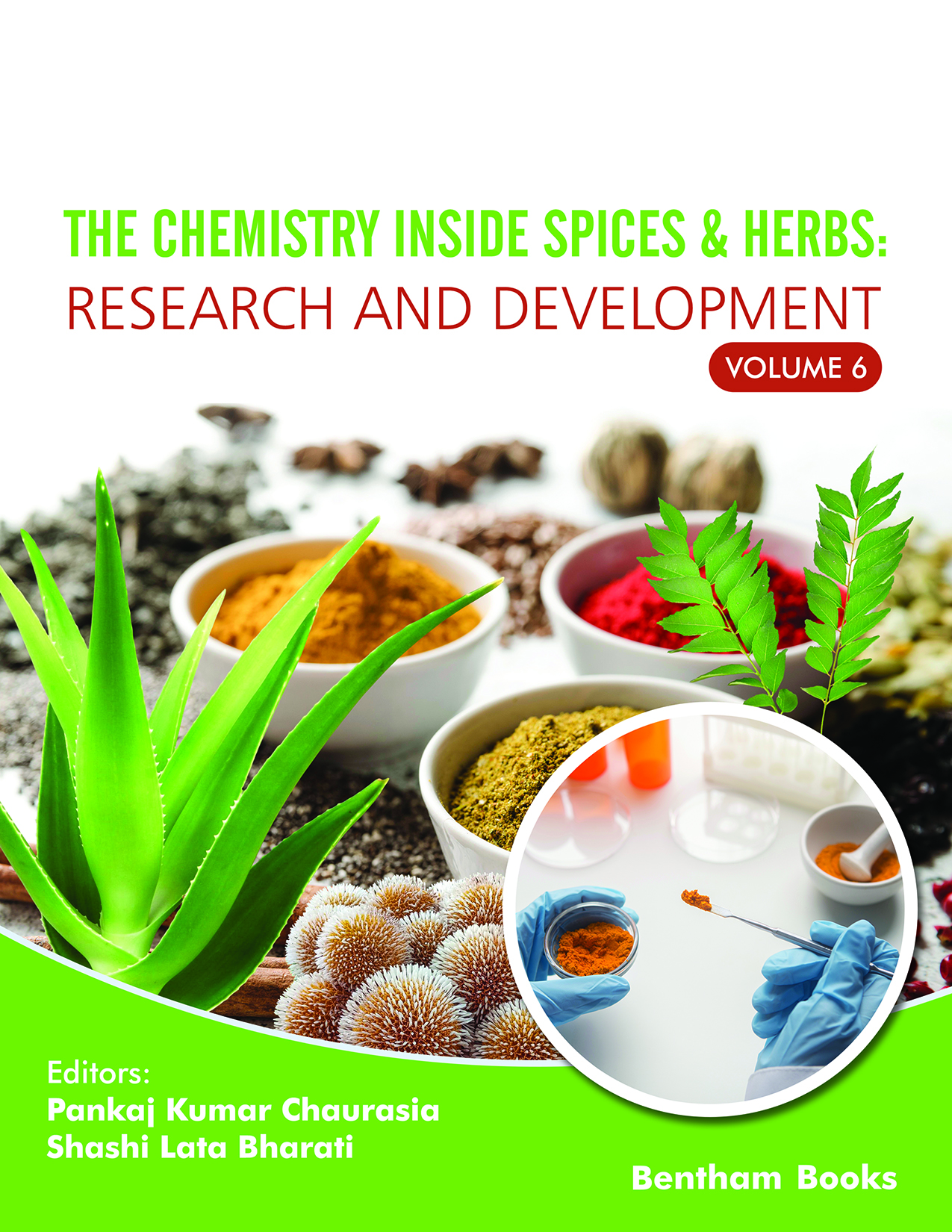
This book, Volume 6 of the book series “The Chemistry Inside Spices & Herbs: Research and Development”, presents an extensive discussion and assessment of various plant genera and species, their chemistry, and medicinal applications. This volume contains nine chapters prepared by experts in the field. The book includes a comprehensive overview of phytochemistry and medicinal uses of Spondias, Taxus, Momordica charantia, Anthocephalus cadamba, Murraya koenigii, and Aloe vera. A detailed overview of biomolecules targeting tubulin, the use of various spices in the therapeutic management of Alzheimer’s disease, and the phytochemistry and utilization of underutilized spices as therapeutic food has also been provided.
Chapter 1, written by Salgado-Cepeda et al., discusses the promising ethno-medicinal uses, phytochemistry, and pharmacology of the genus Spondias. This genus is a valuable resource for pharmacological and nutraceutical applications, with studies confirming its safety and efficacy. Its bioactive composition highlights its usefulness as a therapeutic and functional agent, expanding its applications in health and industry.
Chapter 2, written by Afrose et al., expatiates on the phytochemistry and pharmacology of Taxus. Including such aspects provides a detailed discussion on all the other secondary metabolites in the plant, apart from the taxanes that are the primary bioactive compounds responsible for the anti-cancerous nature of the plant. The chapter further elaborates on the pharmacology of the Taxus extracts and characterizes constituents, including their actions on various forms of cancer. It also presents the difficulties in the conservation and reasonable use of Taxus, as well as the potential for accessing new drugs from this rich source.
Chapter 3, written by Kumari and Rakhra, presents an overview of the chemistry and medicinal applications of Momordica, especially Momordica charantia (bitter melon). The plant is rich in bioactive compounds, such as saponins, alkaloids, flavonoids, triterpenoids, and phenolic compounds, which contribute to its therapeutic potential. Pharmacologically, M. charantia exhibits significant antidiabetic, anticancer, antioxidant, anti-inflammatory, and antimicrobial activities.
Chapter 4, written by Samant et al., presents an overview of Anthocephalus cadamba, encompassing its botanical characteristics, ethnobotanical significance, phytochemical composition, and medicinal applications.
Chapter 5, written by Dutta et al., covers the phytochemical analysis of Murraya koenigii, its everyday practical applications for people, recent research applications, and potential future directions to enhance its accessibility and benefits for the general public.
Chapter 6, written by Kumar et al., discusses the extraction methods, chemical properties, and pharmacodynamics responsible for the Aloe vera plant’s anti-inflammatory, antibacterial, antioxidant, and wound healing properties. Moreover, the chapter discusses the current and potential directions for the application of Aloe vera in clinical practice, as well as possible directions for further scientific investigations.
Chapter 7, written by Patel and co-authors, provides a comprehensive overview of biomolecules targeting tubulin, detailing their chemistry, molecular mechanisms, and therapeutic potential. It explores recent advances in the field and offers insights into the future prospects of these biomolecules. The chapter delves into the structure and function of tubulin, a key protein in cell division, and explains how disrupting its function can effectively halt the proliferation of cancer cells. Additionally, it highlights the evolution of tubulin-targeting agents, from natural products to synthetic and semi-synthetic derivatives, and examines advancements in drug design and delivery systems aimed at enhancing specificity and minimizing toxicity, underscoring the potential of these agents in oncology.
Chapter 8, written by Adhikary et al., offers a summary of the phytochemistry, biological and cellular activities, and potential therapeutic usage of various spices in the therapeutic management of Alzheimer’s Disease.
Chapter 9, written by Bagul and Patel, presents the phytochemistry and medicinal properties of undervalued spices. Undervalued spices have nutritional importance and medical significance; in Ayurvedic medicine, they are valued for their medicinal properties. Hence, the present book chapter deals with phytochemistry and the utilization of underutilized spices as therapeutic food.
Pankaj Kumar Chaurasia
Chemical, Biological and Environmental Laboratory
P.G. Department of Chemistry, Langat Singh College
Babasaheb Bhimrao Ambedkar Bihar University
Muzaffarpur, Bihar, India
&
Shashi Lata Bharati
Department of Chemistry, North Eastern Regional
Institute of Science and Technology (NERIST)
Nirjuli, Arunachal Pradesh
India